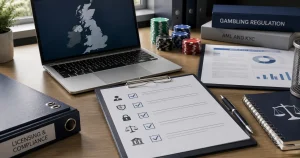


A place name alone does not confirm a current licence or explain how an offshore casino is regulated when something goes wrong.
What “Gibraltar casino” Means in the Offshore Market
When you see “Gibraltar casino” on a website, it is worth slowing down before treating the phrase as a description you can rely on. It may be referring to a casino associated with Gibraltar as a licensing jurisdiction. But the words on a page, by themselves, do not establish that the site holds a current, verified licence there.
The broader category is easier to define. A non-UK-regulated casino is an online gambling site operating without oversight from the UK Gambling Commission. Such casinos may be licensed in other jurisdictions, including Malta, Curaçao, Gibraltar or Anjouan. That does not make all those arrangements equivalent, and it does not mean that every site using one of those place names has proved its status.
That distinction matters because the phrase can do more work in advertising than it does in ordinary conversation. “Gibraltar” can sound like a neat stamp of origin or quality. I used to read labels like that as if they answered the important questions for me. They did not. A place name is a starting point for understanding what a site claims, not a substitute for checking what the claim actually refers to.
What the label may be trying to say
People looking for Gibraltar online casinos may have different things in mind. One person may mean a casino licensed in Gibraltar; another may be searching for a site that is based there, or simply for an international casino using Gibraltar in its description. Those ideas can get bundled together on a page even though they are not the same thing.
So, when a site calls itself a Gibraltar casino, read the surrounding wording rather than assuming the label settles the matter. Is Gibraltar presented as the place connected with the licence, or is the page using it as a broad brand description? Does the site name a regulator, or does it merely mention a location? Those are useful distinctions to notice. They are not proof on their own.
Jackpot Mobile Casinos in the UK: How They Work
I would also be careful with “best” and “top” claims. A page calling itself one of the best Gibraltar online casinos is making a promotional claim, not giving you a neutral definition of the term. The same goes for lists of casino sites described as Gibraltar-based or Gibraltar-licensed. A ranking label tells you how the page wants to position the sites; it does not verify each site’s regulatory status.
That is the plain version. Labels are not evidence.
The wider offshore meaning
In this context, “offshore” is often used to describe a casino operating outside the UK Gambling Commission’s oversight. It does not, on its own, tell you where the company is located, which jurisdiction it is licensed in, or whether the site’s description of its status is accurate. For that reason, I find “non-UK-regulated casino” more useful when the point is the relationship with UK oversight.
A casino may be described as international, offshore, or connected with a particular jurisdiction. Those phrases can overlap, but they are not interchangeable proof of a licence. Gibraltar is one jurisdiction associated with non-UK-regulated casinos; the label should not be stretched into a claim about every casino using it.
This also explains why searches for online casinos in Gibraltar can produce pages that seem to answer different questions. Some may be about casinos connected with Gibraltar as a jurisdiction. Others may use the wording to attract people who want an online casino with an international profile. The phrase alone leaves room for interpretation, so the details on the site matter more than the headline.
I learned not to let a confident badge or a polished page do the thinking for me. If a casino says “Gibraltar” prominently, treat that as a claim to understand, not a conclusion. Establishing what the label means on that particular site takes more than spotting the word.
For now, the useful distinction is simple: a Gibraltar casino is not automatically a verified Gibraltar-licensed casino just because the site calls itself one. And a casino associated with Gibraltar is still a non-UK-regulated casino if it operates without UK Gambling Commission oversight. That is what the term can tell you at a broad level—and where the label stops being enough.
The Main Distinction
A Gibraltar casino is not automatically a verified Gibraltar-licensed casino, and remains a non-UK-regulated casino if it operates without UK Gambling Commission oversight.
Recommended online casinos
- x3betBonus: Welcome Pack 100% Up to £1.000 + 200 Free Spins · Payout speed: 1-3 business days
- EvoSpinBonus: 125% up to €2500 + 125 Free Spins · Payout speed: 1-3 business days
- NightLuckBonus: Welcome Pack + 805% Up To 6400€ + 280 FS · Payout speed: 1-3 business days
- BeOnBetBonus: 100% up to €500 + 100 FS · Payout speed: 1-3 business days
- DieselwinBonus: Welcome Pack 250% up to £4000 + 200 FS · Payout speed: 1-3 business days
- JetsetspinsBonus: 200% Bonus + 100 Free Spins + Free Royal Wheel · Payout speed: 1-3 business days
- ZombillionBonus: Welcome Pack 250% up to £4000 + 200 FS · Payout speed: 1-3 business days
- AmunbetBonus: Join now and get 450% up to 2,700 GBP + 450 FS · Payout speed: 1-3 business days
- SpinFormulaBonus: 550% Up To £15,000 + 550 FS · Payout speed: 1-3 business days
- BritsinoBonus: Welcome Package – Get your £2,200 + 2,000 FS · Payout speed: 1-3 business days
The UK Legal Position: Operators and Players Are Different
When I first looked into a casino online from Gibraltar, I made the mistake of treating the operator’s position and mine as if they were the same legal question. They are not. UK gambling law is principally aimed at the businesses that provide gambling services to the market, rather than at an individual who places a bet.
For Great Britain, the key issue is whether an operator is supplying gambling services to customers here. A company’s registered office or the place where its servers sit does not, by itself, settle that question. An operator serving customers in England, Scotland or Wales needs the relevant UK Gambling Commission licence, wherever the business is based. So “based in Gibraltar” is not a legal shortcut that makes the UK rules disappear.
That distinction matters when you see a site described as one of the best online casinos in Gibraltar, or as a new Gibraltar casino. Those labels may tell you how the site presents itself, or where a business says it is located. They do not answer whether it is authorised to provide gambling to people in Great Britain. A Gibraltar connection and permission to serve the British market are separate matters.
What the law focuses on
The Gambling Act 2005 is concerned with operators supplying gambling services into the British market. In practical terms, the question is not simply whether a casino company has a licence somewhere in the world. It is whether the business is offering gambling to customers in Great Britain and, if so, whether it holds the required UK authorisation.
Casino without a Swedish licence: UK guide
I would not read a site’s “licensed” badge as a complete answer. It might refer to a permission issued by another jurisdiction, while leaving the question of UK authorisation untouched. Nor does a site become a UK-regulated service just because its pages are available to someone using a British address. The operator’s obligations and the player’s situation need to be considered separately.
The law described here applies to Great Britain: England, Scotland and Wales. Northern Ireland is outside the scope of the Gambling Act 2005, so it should not be casually folded into the same statement. If you live there, the relevant legal position needs to be checked separately rather than assumed from a rule that concerns Great Britain.
What about the person playing?
For an individual player, the position is different from the operator’s. UK law does not make it a criminal offence for a player to gamble on a site that lacks a UK licence. The Act’s focus is on the business supplying the service, not on prosecuting the customer for placing a bet.
That is a narrow point, not a stamp of approval. It does not turn an unlicensed site into a legal UK casino, and it does not mean that the operator is entitled to target customers here. It also should not be read as saying that every service offered by a foreign-licensed casino is permitted in Great Britain. The operator’s responsibilities remain its own.
Legal Scope
The Gambling Act 2005 applies to Great Britain (England, Scotland, and Wales), while Northern Ireland remains outside its scope.
British citizens are not expressly barred by UK law from using gambling services licensed in another country. But that fact does not erase the separate requirement on operators serving Great Britain. I find this is where online discussions get tangled: “the player is not committing a criminal offence” becomes “the casino is allowed to operate here”. Those statements are not interchangeable.
A search for real-money casinos in Gibraltar can therefore lead to two quite different questions. One is about the legal status of the company offering the gambling to British customers. The other is about whether an individual player is committing an offence by using the site. The answer to the first can involve the operator’s UK authorisation; the second is not answered by assuming that the player is criminally liable.
Why location can confuse things
People ask why online casinos are based in Gibraltar, or point to a Gibraltar address as if it settles the whole issue. A company can be located outside Britain and still face UK requirements if it supplies gambling services to customers in Great Britain. Location alone does not decide whether those requirements apply.
Equally, a player’s ability to open a page or create an account does not prove that the operator has the necessary permission for the British market. Access and authorisation are not the same thing. That is true whether a site calls itself a new online casino in Gibraltar, a real-money casino, or something else entirely.
Merkur Casino Online UK: Games, Bonuses and Checks
I have learned to separate the questions before trusting a label: where is the operator based, what market is it serving, and what does that mean for its legal obligations? The player’s position is not identical to the operator’s, but that difference should not be mistaken for reassurance about the service itself. No neat shortcut.
Before You Trust a Casino Site, Look at the Protection You Give Up
A casino site can look familiar: polished pages, recognisable games and a tidy cashier. That surface tells you little about what happens when you need help. When you use a non-UK-regulated casino, the practical safeguards available to you may be different from those at a UKGC-regulated operator. I would not treat a Gibraltar casino label as a shortcut to knowing what protection sits behind the screen.
The difference is easiest to miss when everything is going smoothly. You deposit, play, and the site behaves as expected. The protection gap matters when you want to limit your gambling, need support, or have a concern about how your information is handled. Non-UK-regulated casinos may apply less stringent responsible-gambling and data-protection rules than UKGC-licensed operators. That does not mean every site handles those areas badly. It does mean you should not assume the same standards and tools will be there.
Tools you may not have
UK-regulated gambling includes mandatory responsible-gambling tools. At a non-UK-regulated casino, you cannot count on those UK safeguards being available. In particular, do not assume you can use the same built-in controls for managing deposits or excluding yourself that you would expect from a UKGC-licensed site.
Protection Gap
Casinos not on GamStop will not provide the protection of being blocked through that UK-wide self-exclusion scheme.
The distinction matters if you are looking at Casinos not on GamStop. GamStop is a UK self-exclusion service, and a casino outside that scheme will not give you the protection of being blocked through it. A site’s own limits or self-exclusion options, if it offers them, are not a substitute for that UK-wide scheme. Before creating an account, look for the controls the operator actually provides and consider whether they would be enough for you.
I learned the hard way that a tool is most useful before you need it. A friendly-looking responsible-gambling page is not the same thing as a required safeguard. Check what you can set, how it works, and whether you can get help if you want to change your gambling behaviour. If those details are hard to find, that is worth taking seriously.
Where a complaint can go
There is also a difference in where you can turn for help. If you gamble with an offshore operator, you give up access to the UK’s Financial Ombudsman Service in relation to that gambling service. You should not expect to use UK complaint channels as a fallback just because you are in Britain or the site is easy to reach.
That can make a disagreement feel very different from a routine customer-service problem. A confusing account decision or an unsatisfactory response may leave you relying on the operator’s own process, rather than a UK route for escalating the matter.
Privacy deserves the same careful look. A casino may ask for personal and account information, but non-UK-regulated casinos may be subject to less stringent data-protection rules than UKGC-licensed operators. Read the privacy information before sharing details, and be clear about who is collecting them and how the site says it will use them. A polished design is not evidence of stronger data safeguards.
Judge the protection, not the presentation
Searches for the best online casino in Gibraltar can lead to pages that focus on games, offers and convenience. Those details do not answer the more important question: what support and safeguards would you have if something went wrong? For any casino site associated with Gibraltar, look beyond the headline and check the responsible-gambling information, privacy terms and complaint process.
I would keep the decision simple: if you need UK-mandated tools or the UK’s Financial Ombudsman Service as a safety net, a non-UK-regulated casino does not provide that same protection. That is a real trade-off, not a small-print technicality. Appearance can wait. Protection cannot.
A Gibraltar Licence Is Not a UKGC Licence
A Gibraltar licence and a licence from the UK Gambling Commission are not two names for the same approval. They come from different regulators, and one does not stand in for the other. I used to see a familiar jurisdiction on a casino’s footer and take it as a sort of all-purpose stamp. That was too generous an assumption.
The key point is where the operator serves customers, not simply where the company is based. An operator serving customers in Great Britain needs a UK Gambling Commission licence, even if its headquarters or licensing arrangements are elsewhere. A Gibraltar licence does not erase that requirement or turn the operator into a UKGC-licensed casino.
That distinction matters when a site describes itself as a Gibraltar online casino. The wording tells you what the operator is claiming about its licensing, not whether that claim is accurate, current, or relevant to its service for people in Great Britain. A label on a homepage is not the same thing as checking the named company and the licence it says it holds.
I’d separate two questions before giving the label much weight: does the operator actually hold the Gibraltar authorisation it claims, and does it hold the UK Gambling Commission licence required to serve Great Britain? Those are separate checks. Finding an answer to the first does not answer the second.
What “licensed in Gibraltar” does—and doesn’t—say
The phrase “Gibraltar licensed” can sound reassuring because it names a regulator rather than describing the casino as simply unregulated. But it does not mean the UKGC has approved the site. Nor does the phrase, by itself, show that the operator is authorised to serve customers in Great Britain.
This is where wording can blur the issue. A casino may be connected to a company based in Gibraltar, may claim to hold a Gibraltar online gambling licence, or may use Gibraltar prominently in its marketing. Those details are not interchangeable. And none changes the UK requirement for an operator serving the British market.
For a search like “gibraltar casino license uk 2026”, the useful answer is not a list of sites carrying a Gibraltar label. It is the distinction between a jurisdiction named by an operator and the authorisation required for the market it serves. If a site presents a Gibraltar licence as proof that it can offer gambling to customers in Great Britain, that claim confuses two different things.
The same caution applies to “online casinos licensed in Gibraltar” as a broad category. The phrase does not tell you whether every site using it has a verified licence, whether the licence belongs to the company operating the casino, or whether the operator holds the separate UKGC authorisation relevant to Great Britain. Don’t let a neat badge do all that thinking for you.
A Gibraltar licence may describe a regulatory relationship outside the UKGC system. It is not a shortcut to UKGC status. If you are assessing a site’s position in Great Britain, the question that matters is whether the operator holds the UK Gambling Commission licence required for that market. The company’s base does not change the answer.
Different licence. Different question.
Gibraltar and Other Offshore Licences: Don’t Treat Them as Interchangeable
A casino’s licence points to a jurisdiction, not to a universal standard. Gibraltar, Malta, Curaçao and Anjouan are all names you may see attached to non-UK-regulated casinos, but the names alone do not tell you what the operator is permitted to do in every market. I used to read a licence badge as a general seal of approval. That was too easy.
Gibraltar
A jurisdiction associated with non-UK-regulated casinos; a licence here does not replace the need for UKGC authorisation to serve the British market.
Anjouan
A jurisdiction where licences do not mandate segregated player funds, random number generator testing, or regulatory mediation for complaints.
Malta / Curaçao
Other jurisdictions where non-UK-regulated casinos may be licensed, each with different regulatory standards.
The practical question is not simply whether a site says it has a licence. It is which authority issued it, which company holds it, and where that authorisation applies. A licence can matter within the jurisdiction that issued it without giving its holder permission to serve customers elsewhere. Those are separate things.
Anjouan makes the distinction clear. An Anjouan casino licence does not authorise an operator to run gambling services in the United Kingdom or in other restricted markets. Seeing that licence displayed on a site therefore does not establish permission to serve British customers. The word “licensed” may be accurate in one context and still leave the key market question unanswered.
That is why I would not compare a Gibraltar casino and an Anjouan casino as though they were two versions of the same product. The issuing jurisdictions differ, and a claim tied to one does not automatically describe the other. Nor does the presence of a licence name, by itself, tell you how a particular operator handles customers or whether its claims match the authorisation it holds.
The same caution applies when browsing lists labelled as the top Gibraltar casino sites. A ranking can put several brands together, but that does not make their regulatory position interchangeable—or confirm that every site using the Gibraltar label has a verified Gibraltar licence. Treat the label as something to check, not as proof.
There are also specific differences in what Anjouan-licensed casinos are required to provide. They are not required to integrate GAMSTOP, and they do not have to offer an independent alternative dispute resolution process comparable to services approved under the UK system. Those points should not be casually attributed to Gibraltar: a detail about one jurisdiction is not a description of another.
I’d keep the comparison narrow and concrete. Identify the jurisdiction named, check that the operator’s own licensing claim is consistent, and do not assume that permission in one place travels with the brand into another. A familiar badge can look reassuring. It does not answer every question.
What an Anjouan Licence Does—and Doesn’t—Verify
A licence can sound like a neat stamp of reassurance. I’ve learned to look past the label and ask what the rules actually require. With an Anjouan casino licence, the key point is that the framework does not mandate several protections players may assume are part of being licensed.
Player funds are one example. Anjouan’s rules do not require casinos to keep customer money separate from the operator’s own funds. That does not prove a particular casino has mixed the money, but it means the licence itself does not guarantee separation. If the operator fails, players are unsecured creditors. In plain English, your balance is not guaranteed to be ring-fenced for you.
Financial Risk
An Anjouan licence does not require casinos to keep customer money separate from operator funds, meaning your balance is not guaranteed to be ring-fenced if the operator fails.
That is a detail worth noticing before a balance starts to feel like money safely waiting in an account. It may look like a number you can withdraw, but the licence does not promise that customer funds sit apart from the business’s funds. The distinction matters most when the company cannot meet its obligations. Not a small detail.
Game testing is another gap. The Anjouan framework does not require random number generator testing or audits. That is not evidence that every game is faulty or that every operator avoids testing; it means those checks are not mandated by the framework. So an Anjouan casino licence, by itself, does not verify that an independent testing process has been carried out or that audits are part of the operator’s obligations.
I wouldn’t turn that into a claim about how any one game behaves. The narrower point is more useful: the licence does not make those checks a required condition. If a site makes a broad claim about testing, look for what it says was tested and by whom, rather than treating the licence name as proof.
Complaint handling has a similar limit. The Anjouan authority does not take up player complaints, mediate between a casino and a customer, or decide disputes. A licence therefore does not mean you can send a complaint to the authority and expect it to resolve the matter.
These gaps are about what the framework requires and what its regulator does. They do not establish that every Anjouan-licensed operator behaves badly. But they do set a boundary around what the licence can verify: it does not guarantee segregated funds, mandated game testing or audits, or regulatory handling of an individual player’s complaint. That’s the part I’d keep in mind when a site presents the licence as a complete seal of trust.
Slots, Casino Companies and the Payment Route Behind Them
When I look at a Gibraltar-branded slot site, I try not to treat the game lobby and the cashier as one thing. A casino company may run the account, while payment processing goes through another service. That extra link matters: the method shown on the deposit screen may not tell you exactly who handles the transaction or whether the same route will be available for a withdrawal.
Non-UK-regulated casinos may list cards, e-wallets, bank transfers and cryptocurrency as ways to fund an account. Some use alternative processors, so the route can look different from a direct payment to the casino company. Read the cashier instructions before sending money, and check the terms for the method you intend to use. A payment option appearing on the deposit page is not, by itself, confirmation that it can also be used to withdraw.
There is a specific UK issue with credit cards. The UK ban concerns gambling funded by credit cards; it does not mean every payment route displayed by a non-UK-regulated casino is equivalent to a debit-card payment. Crypto can bypass the credit-card-funded gambling ban because the transaction is made in cryptocurrency rather than charged to a credit card. That does not make crypto a safer route or remove the need to understand how the site handles deposits and withdrawals.
Curacao Casino Licence in the UK: What It Means
I have learned not to read a list of payment logos as a promise. A card payment may pass through a processor, and a crypto deposit has its own steps before the casino account shows the funds. If a transaction is delayed or rejected, the processor’s instructions and the casino’s terms may both become relevant. Keep records of what the cashier displayed and what you actually sent.
Some payment descriptions need extra caution because they may not reflect a stable, widely available option. A specialist review reports that certain sites have allowed deposits to be charged to a mobile phone bill or taken from a prepaid balance. Treat that as a report about particular services, not a standard feature of Gibraltar slot sites; availability can change.
For me, the practical check is simple: identify the payment route, its processor where that information is shown, and the rules for moving money back out. Don’t assume that a familiar logo means a familiar level of protection. The route is part of the product.
Real-Money Slots: Read the Bonus Terms Before You Deposit
A welcome offer can look like extra money for real-money slots, but the headline figure tells you very little. I’ve made that mistake: I noticed the bonus and barely read the conditions attached to it. The useful question is what you must do before any winnings can be withdrawn.
Start with the wagering requirement, then find out what it applies to. A specialist review has reported offshore welcome offers with requirements of 35x or more; treat that as a warning to inspect the specific offer, not as a rule for every casino. A separate specialist review describes a 40x requirement that can be calculated against the bonus and deposit together, the bonus alone, or the bonus and free spins together. Those are very different sums to clear.
“Big bonus” is the sales line. The calculation is the catch. Check the offer’s own terms for the qualifying amount, which games count, and whether the bonus must be accepted or activated. If the wording does not make the calculation clear, you cannot reliably judge the offer’s value before depositing.
Free spins need their own check. A specialist review has reported packages that expire within 24–72 hours. That is a tight window if you are not planning to play straight away. Look for when the spins become available, when they expire, and whether winnings from them carry a separate wagering condition. The review’s reported timeframe is not a promise that another site will give you the same window.
I now read the terms before I deposit, not after. I also check whether the bonus is optional and what happens if I decline it; an offer can come with restrictions you would rather avoid. A bonus that cannot be used on the games you want may be less useful than it looks, even before you consider the wagering.
For anyone comparing Gibraltar-facing casino sites, the label does not tell you how an individual promotion works. Read the specific terms attached to the account and offer. If you cannot tell what must be wagered, or how long you have to use the spins, do not treat the headline as cash in hand. It is only an offer.
Evaluate Bonus Terms
- Check the exact wagering requirement (e.g., 35x or 40x).
- Determine if requirements apply to the bonus alone or bonus and deposit combined.
- Verify the expiration window for free spins (e.g., 24–72 hours).
- Identify which specific games count towards the wagering goal.
- Confirm if the bonus is optional and what happens if it is declined.
A New Casino Is Not Automatically a Safer Casino
A new online casino using a Gibraltar label can look polished before it has built any track record. I used to take a fresh design as a sign that the people behind it had things in hand. It tells you very little about what happens when you ask for your money back.
Start with the withdrawal terms, not the welcome page. Published accounts of non-UK-regulated casino withdrawals disagree: some describe payouts arriving within 24 hours to 5 business days, while others report waits of three or four weeks. Those are very different experiences. With no regulatory clock to enforce a payout deadline, a promised processing time may not give you much leverage if it slips.
Check whether withdrawals are capped by day, week or month. A specialist review has reported that some casinos set limits of this kind, meaning a large win could be paid in instalments rather than in one go. Treat that as something to verify in the casino’s own current terms, not as a rule that applies to every new site.
Then look at verification. A casino may ask for more than the documents you expect before releasing a withdrawal; specialist reviews have reported requests for notarised paperwork or video calls. That can turn a simple cash-out into a drawn-out process. Read the withdrawal and identity-check sections before depositing, and save a copy of the terms you saw. Boring, but useful.
I now judge a new casino by the awkward moment, not the glossy launch. Can you find the withdrawal limits? Are the conditions clear? Does the site explain what happens if verification takes longer than expected? If those answers are hard to locate, that uncertainty is part of the decision. A new name is not proof of safer handling. Keep your expectations modest.
What Offshore Casino Regulation Means When Something Goes Wrong
A dispute is where the difference between a licence label and a useful remedy becomes real. I used to assume that if a casino had a regulator named in its footer, I could take an unresolved complaint to that regulator. That was too simple.
At a non UK regulated casino, you cannot use the UK Gambling Commission’s complaints process or an approved UK alternative dispute resolution service. A complaint to the operator may still be possible, but that is not the same as having an independent body review the case. Keep copies of messages, transaction records and the terms that applied when the dispute began. Small details matter.
Gibraltar casino regulation is not, by itself, a promise that a UK complaint route is available. If a site says its licence gives you access to an external complaints process, find out who actually handles it and what the process covers. A badge or a help-page link does not answer that.
The Anjouan position is clearer, though not reassuring. Its authority does not take up player complaints, mediate between a player and a casino, or decide who is right. Anjouan-licensed casinos also do not offer an independent dispute process comparable to the ADR services associated with UKGC-regulated operators. The operator is required to respond to a complaint within 30 calendar days under that framework; a response is not the same as an independent decision.
That is the point I now check before I deposit: not merely who issued the licence, but who can act if the casino rejects my case. If there is no independent route, you may be left dealing with the operator itself, without access to UK regulators. Be realistic about that limit before money is involved. No neat appeal button.
Is it legal for a UK player to gamble at an Anjouan-licensed casino?
Yes, UK law does not explicitly prohibit you from using gambling services licensed in another country, and players do not commit a criminal offence by gambling on an unlicensed site. An Anjouan licence does not authorise the casino to operate in the UK.
What is the biggest risk of playing at a non-UK-regulated casino?
You may have little recourse if the casino withholds your money: Anjouan’s authority does not handle player complaints, and there is no independent dispute-resolution route comparable to UK-approved services. Your funds may also be unsecured if the operator fails.
Are Anjouan casinos connected to the GamStop self-exclusion scheme?
No. Anjouan-licensed casinos are not required to integrate GamStop.
Can I complain to the Anjouan regulator if a casino won’t pay me?
No. The Anjouan authority does not mediate or adjudicate player complaints, though operators must respond to complaints within 30 calendar days.
How do casinos outside GamStop operate?
They operate without UK Gambling Commission oversight and may be licensed in another jurisdiction, such as Anjouan. They are not part of GamStop, and an overseas licence does not authorise them to serve customers in Great Britain.
Material created by the team Basswin UK Guide