

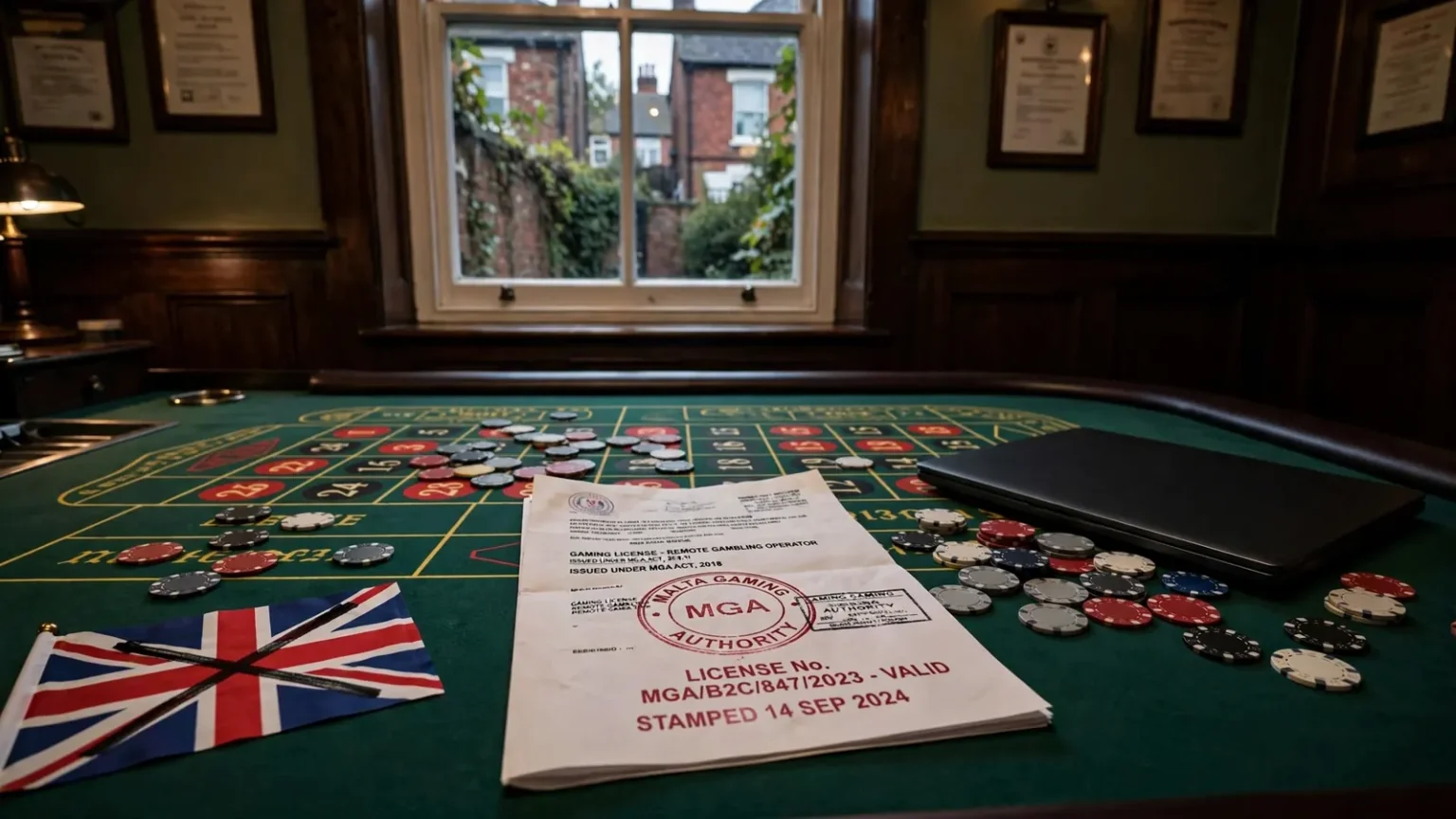
A practical guide to overseas licensing, withdrawal terms, payment checks and protections unavailable outside UKGC oversight.
What “Non-UK-Regulated” Actually Means
A non-UK-regulated casino is an online gambling site that operates without oversight from the UK Gambling Commission (UKGC). The phrase describes the regulator it does not answer to; it does not, by itself, tell you whether the site has a licence elsewhere. That distinction is easy to miss when a homepage puts a licence badge beside a confident promise of being “trusted”. A badge may point to a different jurisdiction’s licensing system, not UKGC regulation.
You may also see “casino without a UK licence” used as shorthand. In plain terms, that means the operator does not hold a UKGC licence. It is not a separate kind of game or payment service, and it does not tell you where the operator is based. The site might be connected to a company or licensing jurisdiction outside the UK, but the label alone does not establish those details.
The UKGC’s role is the useful dividing line here. Casinos operating without its oversight sit outside the UKGC regulatory system. A licence issued elsewhere does not turn into a UKGC licence because the operator displays it prominently, or because the site accepts a particular currency or has familiar-looking games. Different authorities have different rules and responsibilities. The word “licensed” needs a jurisdiction attached to it.
What a foreign licence tells you
Non-UK-regulated casinos are commonly licensed in jurisdictions such as Malta, Curaçao, Gibraltar or Anjouan. Those names refer to different licensing jurisdictions, not a single shared regulator. So “foreign-licensed” is a broad description, not a quality rating. It tells you that a licence may have been issued outside the UK, but it does not tell you that every jurisdiction provides the same oversight.
I used to treat a licence logo as if it settled the question. It didn’t. The detail that matters is which authority the operator says issued the licence, and whether that claim can be matched to the operator in question. A logo on a page is a claim, not an explanation. Even the word “regulated” can blur two different things: oversight by the UKGC and licensing by another jurisdiction.
Curacao Casino Licence in the UK: What It Means
That is why “online casino without a UK licence” and “unlicensed casino” are not automatically interchangeable phrases. The first describes the absence of a UKGC licence. The second can sound as though no licensing authority is involved at all. A site may lack UKGC oversight while being licensed somewhere else; whether it is licensed, and by whom, has to be considered separately. The wording matters. Small distinction.
Don’t read more into the label
Searches for a new casino without a UK licence, or for the best casino in that category, can make the category sound like a shortlist of comparable options. But the shared feature is only the lack of UKGC oversight. It does not establish that the sites have the same licence, operator, rules or protections. Nor does a new launch tell you anything by itself about the regulator behind it.
I would not use “best” as a shortcut for “safe” here. It is a promotional judgement unless the criteria are clear, and the UKGC status is still a separate question. A site can describe itself as international, foreign, or licensed abroad; those descriptions do not mean it is overseen by the UKGC. Conversely, the absence of a UKGC licence does not, on its own, reveal which other authority may be involved.
When checking how a site describes itself, separate three points: whether it has UKGC oversight, whether it claims a licence from another jurisdiction, and which jurisdiction that is. Keep those statements distinct rather than letting one stand in for the others. “Licensed” is incomplete without the name of the licensing authority; “UK-regulated” specifically refers to UKGC oversight in this context.
That is all the label can safely tell you at first glance. A non-UK-regulated casino operates without UKGC oversight, while it may be licensed in Malta, Curaçao, Gibraltar or Anjouan. The jurisdiction names are not interchangeable, and the word “licensed” does not erase the difference between them. Start with the regulator, not the sales copy.
The Legal Position for UK Players
The first thing I’d separate is the operator’s position from yours. A casino that takes customers in Great Britain needs a UK Gambling Commission licence, even if the company is based abroad. That requirement is aimed at the business supplying gambling services to the British market. It does not automatically mean that an individual player commits a crime by using a site licensed elsewhere.
Legal Distinction
UK law does not expressly make it a criminal offence for a British citizen to use gambling services licensed in another country, though the operator itself may be in breach of licensing rules by serving the UK market.
That distinction is easy to blur when a site describes itself as “international” or holds a licence from another country. Those words tell you something about where the operator says it is regulated; they do not make that licence a substitute for permission to serve customers in Great Britain. If an operator accepts British customers without the required UKGC licence, the licensing issue is with the operator.
For players, the position is different. UK law does not expressly make it an offence for a British citizen to use gambling services licensed in another country, and playing on an unlicensed site is not itself a criminal offence under UK law. That is a narrow point about criminal liability. It is not an assurance that every overseas gambling arrangement is lawful in every circumstance, nor does it make the operator’s activity compliant with British licensing rules.
I used to read “not illegal for the player” as if it meant “nothing to think about”. That was too neat. The operator may still be operating outside the UK regulatory system, and you may have to deal with the practical consequences yourself if something goes wrong. The legal distinction answers one question—whether the player is committing a criminal offence simply by gambling there—not every question about the site, the transaction or the terms you accepted.
The phrase “casino without a UK licence” can also mean different things in casual conversation. A site may be licensed by a foreign jurisdiction but not hold a UKGC licence; another may make claims about licensing that are difficult to verify. Neither description changes the rule for operators serving Great Britain. A foreign licence does not grant permission to serve that market in place of a UKGC licence.
Online casinos with no sister sites in the UK
There is a geographic detail worth keeping straight, too. The Gambling Act 2005 governs England, Wales and Scotland, but not Northern Ireland. So the position described here is about Great Britain; if you are in Northern Ireland, check the rules that apply where you live rather than assuming that the same legal framework covers you.
Before using a gambling service based overseas, check your own local laws and think through what using that service could mean for you. Your citizenship alone does not answer every jurisdictional question, and a site’s own legal wording is not a substitute for checking the rules that apply to your circumstances. Keep the two points separate: operators taking customers in Great Britain need the relevant UKGC licence, while a player’s use of an overseas service is not, on its own, a criminal offence under UK law.
That distinction matters. It is not a recommendation to play at an unlicensed site, and it does not turn a foreign licence into a UK one.
Anjouan Licensing: What the Licence Does—and Doesn’t—Cover
An Anjouan casino licence is not permission to serve customers everywhere. In particular, it does not authorise an operator to run gambling services in the United Kingdom or in other markets that Anjouan lists as restricted. That distinction is easy to miss when a site displays a licence badge as if it settled the question of where it can operate.
An Anjouan licence does not authorise an operator to provide gambling services in the United Kingdom; for that market, a UK Gambling Commission licence is required.
For Great Britain, an operator offering gambling to customers must hold a licence from the UK Gambling Commission, wherever the operator is based. An Anjouan licence does not replace that requirement. So when I see “licensed” on a casino’s homepage, I don’t treat the word as a complete answer. I want to know which authority issued the licence, what markets it covers, and whether the operator is authorised for the market it is trying to serve.
That is the limit in plain terms. A licence has a scope.
It also matters what an Anjouan licence does not require of the casino. An Anjouan-licensed operator is not required to connect to GAMSTOP. GAMSTOP is the UK Gambling Commission’s self-exclusion scheme, and a casino outside it will not be covered by a self-exclusion registered there. The licence does not make that site part of the scheme simply because it accepts customers from somewhere else.
The same gap applies to complaints. Anjouan-licensed casinos are not required to offer an independent dispute-resolution process comparable to the services approved for UKGC-licensed operators. The Anjouan authority does not mediate or decide player complaints. Its framework does require the operator to respond to complaints within 30 calendar days, but a response from the operator is not the same thing as an independent decision on the dispute.
I would not read that response requirement as a promise that a complaint will be resolved in your favour, or that the regulator will step in if you remain unhappy. It describes what the operator must do; it does not create the same independent route for challenging the outcome.
UK Online Casinos Without Registration: What It Means
That difference is why the licence badge can tell you less than it first appears to. It may identify an operator’s licensing framework, but it does not establish that the casino is authorised to serve the UK market, enrolled in GAMSTOP, or covered by comparable independent adjudication. Those are separate questions, and the badge cannot answer all of them.
If a site presents its Anjouan licence as proof that it is suitable for UK customers, I would be cautious about that wording. The licence itself does not authorise UK operations. A casino not licensed by the UKGC remains outside the UKGC’s operator-licensing framework, even if it holds a licence elsewhere. That’s the point to keep hold of: the issuing jurisdiction and the market being served must match.
I’ve learned not to let one official-looking label do all the thinking for me. Check what the licence actually permits and what obligations it places on the operator. A badge is not a shortcut.
Anjouan, Malta, Curaçao and Gibraltar: Not the Same Safeguards
A licence from Anjouan, Malta, Curaçao or Gibraltar is not a single, interchangeable promise about how a casino is checked. I used to see a jurisdiction name in a footer and treat it as a quick stamp of reassurance. That tells you where a licence comes from; it does not, by itself, tell you what checks or complaint routes apply.
For Anjouan, the limits are specific. Its framework does not require casinos to have their random number generators tested, undergo audits, or keep player funds separate from business funds. An operator might choose to take some of those steps, but the licence framework does not make them a requirement. That distinction matters: a claim made by a casino is not the same thing as a safeguard imposed by its regulator.
Anjouan
Does not mandate RNG testing, audits, or the separation of player funds from business funds.
Malta, Curaçao, Gibraltar
Different jurisdictions with varying requirements; their licences are not equivalent to each other or to Anjouan.
Malta, Curaçao and Gibraltar should not be collapsed into the same category as Anjouan simply because all four names appear on non-UK casino sites. Nor should their licences be treated as equivalent to each other. The practical thing to check is what the particular regulator requires and what route you have if the operator disputes your account. A jurisdiction’s name alone cannot answer either question.
Complaints show the gap clearly in Anjouan’s case. Its rules require an operator to respond to a complaint within 30 calendar days, but the Anjouan authority does not handle, mediate or decide player complaints. A response deadline is not an independent decision on the dispute. And Anjouan-licensed casinos do not offer an independent dispute-resolution route comparable to services approved by the UK Gambling Commission.
That leaves a meaningful difference between “the operator has to reply” and “someone independent can review what happened”. If the operator rejects your complaint, the Anjouan framework does not provide that independent adjudication. Keep that in mind before treating a licence badge as a safety net.
I’m not saying every casino licensed in Anjouan will fail to test its games or keep funds separately. The point is narrower: those protections are not mandated by the framework, so you cannot assume they are in place just because the site displays an Anjouan casino licence. For Malta, Curaçao and Gibraltar, check the requirements attached to the specific licence rather than borrowing assumptions from another jurisdiction.
The badge is only a starting point. The rules behind it matter more.
What Happens When You Try to Withdraw
A balance on screen is not the same thing as money in your account. I learnt to stop treating the word “instant” as a promise: a withdrawal can involve an internal review, identity checks and the casino’s own processing queue before anything is released. At a non-UK-regulated casino, you may have little leverage if that process drags on.
The reported timings are not consistent. Some accounts put withdrawals from Casinos not on GamStop at between 24 hours and five business days, depending on the payment method. Other accounts say a withdrawal from a non-UK-regulated casino can take as long as three or four weeks. That difference matters: the faster estimate is not a deadline you can rely on, and there is no regulatory clock requiring the operator to complete a withdrawal by a set point.
A delay does not automatically mean a casino is refusing to pay. But it can be hard to tell the difference between a routine check and a process that is going nowhere. The operator may ask for more information, say a review is still pending, or give you a new reason to wait. Keep copies of the terms that applied when you requested the withdrawal, along with messages, dates and screenshots of your account. If the explanation changes, a written record is more useful than trying to reconstruct the conversation later.
Checks can become a hurdle
Identity and account checks are not unique to non-UK-regulated sites. The concern is how much is requested, how clearly the requirement was explained, and whether the casino gives you a workable way to complete it. A specialist review has reported cases in which offshore operators asked for notarised documents or a video call before allowing a withdrawal. That is a reported practice, not something I would assume every operator will require.
Do
- Read verification terms before depositing
- Use only stated secure processes for documents
- Keep records of all communication and uploads
Don’t
- Assume a new launch ensures a smooth cash-out
- Alter documents to fit a request
- Deposit more funds to resolve a pending withdrawal
Read the verification terms before depositing, not after a win. Check what documents could be requested and whether the casino says it can ask for additional checks later. If a new non-GamStop casino is vague about the process, its recent launch is no reason to assume the cash-out experience will be smooth. “Quick withdrawals” can sound reassuring; the detail that matters is what the operator can require before approving one.
Send only documents through the casino’s stated secure process, and keep a note of what you provided and when. If it asks for something you do not understand, ask for a clear explanation in writing before sending it. Do not alter documents to make them fit a request. That can turn a frustrating review into a more serious account problem.
Limits can stretch a large payout
A specialist review has also reported offshore casinos with daily, weekly or monthly withdrawal limits. Under those terms, a large balance may have to be paid in instalments rather than in one go. This is not a condition I would treat as universal: it is a specific risk to check in the withdrawal rules of the casino you are considering.
Look for the limit itself, how it applies to your account, and whether the operator can change or pause a request. A limit can make a payout take longer even when each individual instalment is processed without a dispute. If the terms are difficult to find or leave the operator broad discretion, factor that uncertainty in before you play.
If a withdrawal is delayed, keep communication calm and factual. Ask what is outstanding, what action you need to take and when the operator expects to review the request. Save the answer. Do not deposit more just because support suggests it might help resolve a pending withdrawal; a new deposit does not establish that an existing balance will be released.
This is where I now draw the line between a displayed balance and money I can actually use. Check the withdrawal rules before you risk a deposit, and be prepared for delays, extra verification or instalments. At a non-UK-regulated casino, waiting can be part of the risk.
Playing Outside UKGC Oversight: The Protections You Give Up
The difference with a casino outside UKGC regulation is not just a line on a licence page. It affects what happens when gambling starts to feel difficult, when your personal information is involved, or when you believe the operator has treated you unfairly.
UKGC-licensed operators must provide mandatory responsible-gambling tools. At a non-UK-regulated casino, you do not have the same guaranteed set of protections. A site may offer ways to manage gambling, but you should not assume those options are required, work in the same way, or will be available when you need them. That matters most when you are trying to put a firm boundary between yourself and further play. A tool that exists only at the operator’s discretion is not the same safeguard.
The distinction is just as important with personal data. Non-UK-regulated casinos may operate under less stringent data-protection rules than UKGC-licensed operators. That does not mean every such site mishandles information; it means you may have fewer consistent protections to rely on. Before handing over personal details, read the site’s privacy terms and consider whether you are comfortable with how it says that information will be used.
Loss of Protections
By playing at an offshore casino, you give up access to the UK’s Financial Ombudsman Service and mandatory UKGC responsible-gambling tools.
There is also a practical limit if a dispute develops. When you play at an offshore casino, you give up access to the UK’s Financial Ombudsman Service and the mandatory responsible-gambling tools attached to UKGC oversight. You cannot treat the UK’s usual route for raising a complaint as a fallback if the operator’s response disappoints you. That can leave you with less leverage.
I would not read polished wording about “player care” as proof of equal protection. The useful question is what support and controls you can actually rely on, and what happens if the operator does not resolve a problem. Less oversight means fewer familiar backstops. That’s the real trade-off.
GamStop Won’t Block Every Gambling Site
GamStop is a self-exclusion scheme for gambling sites licensed by the UK Gambling Commission. A casino operating outside that scheme is not connected to it, so a GamStop registration will not block access to every gambling website. That distinction matters most if you signed up because gambling had become difficult to control.
I understand the appeal of looking for a way around a block. In a bad moment, “just one more site” can sound like a harmless loophole. It isn’t. Searching for an online casino not on GamStop can turn a decision you made to protect yourself into something you have to fight all over again.
What self-exclusion does—and does not do
When you register with GamStop, the scheme applies to participating UKGC-licensed gambling sites. Casinos not on GamStop sit outside that system. They are not made inaccessible by your GamStop registration simply because you are in Britain or because you have excluded yourself from UKGC-licensed sites.
That does not mean GamStop has failed. It means its reach is limited to the operators connected to it. A search result, advert, or “alternative” casino may still be visible even when you have taken steps to stop yourself gambling through the scheme. Seeing one is not a sign that it is safe to use, or that your original decision no longer matters.
I’ve learned to distrust the word “alternative” when it is being used to make a risky choice sound like a fresh start. A casino being outside GamStop is not a workaround with the same protections. It is outside the scheme.
If you have self-excluded, pause before acting
If you are looking for a casino not on GamStop because GamStop is stopping you from gambling, take that as a signal to step away rather than a reason to keep searching. You do not need to decide anything about another site in the heat of the moment. Close the page, put some distance between yourself and the urge, and tell someone you trust what is happening.
It can help to make access harder in practical ways: remove saved gambling links, sign out, and avoid keeping payment details ready for an impulsive deposit. Those steps are not a substitute for support, but they can interrupt the short window between an urge and an action. If you have already self-excluded, don’t treat a site that remains reachable as permission to gamble.
GamCare and GambleAware are UK support services that readers can contact for help with gambling-related concerns. If the urge feels immediate or you are worried about what you might do next, reach out to someone rather than trying to manage it alone. Asking for help is not an admission that you have failed. It is a practical next step.
Support First
If you have self-excluded, a site being outside GamStop is not a safe workaround; seek professional support from GamCare or GambleAware instead.
Be wary of “best” claims
You may see pages describing the best non-GamStop casinos, or hear about an MGA-licensed or Curaçao-licensed casino that is not on GamStop. Those labels do not change the central point: a site outside the UK scheme is not blocked by your GamStop registration. Nor does a bonus, a familiar game, or a polished-looking page reconnect it to that scheme.
I would be especially wary of advertising that frames the absence of GamStop as a benefit. “More freedom” can mean fewer barriers at the very moment a barrier was the point. A non-GamStop casino bonus is still an inducement to gamble, not a safety feature. If you self-excluded to stop or reduce gambling, a bonus offer is not a good reason to reopen the door.
There is no responsible “best” list for someone trying to bypass their own self-exclusion. A list can make the search feel like ordinary shopping, when the reason for searching may be that gambling is causing harm. I would not mistake recommendations, licence labels, or attractive terms for a replacement for the safeguards you chose.
Keep the decision you made in view
A GamStop registration does not cover casino sites outside its scheme, and it does not prevent you from encountering them online. That is precisely why the decision to self-exclude needs support beyond relying on a block alone. If you have been searching for a way to gamble despite registering, stop browsing those sites and speak to someone who can help you hold the line.
No clever workaround. Just a pause, and support.
Payments at Offshore Casinos: Check Both Deposit and Withdrawal Terms
The payment page can make a non UK regulated casino look refreshingly simple: card, e-wallet, bank transfer, perhaps cryptocurrency. I’ve learned not to treat that row of logos as a promise. It tells you what the site may accept for deposits; it does not confirm that the same method will be available when you want to withdraw.
Some sites route transactions through alternative processors, so the name shown during payment may not be the casino’s name. Read the payment instructions before entering your details, and check whether the processor, currency and account requirements match what you can actually use. A method appearing on a cashier page may still depend on your location or the individual transaction.
Credit cards, e-wallets and bank transfers may all be offered. Cryptocurrency is another possibility. Crypto payments can bypass the UK restriction on gambling funded by credit cards, but that is a route around a payment restriction, not a sign that the transaction has the same safeguards as an ordinary card payment. Check the conversion, wallet and withdrawal details before sending funds; crypto transfers are not something to click through casually.
A specialist review has also reported some casinos accepting deposits charged to a mobile phone bill or taken from a prepaid balance. Treat that as a possibility to verify, not a standard option: availability can change, and the operator’s own current payment terms matter more than an old description.
Then look for the exit route. If a site accepts a deposit by card, that does not mean it will return winnings to that card. It may require a different withdrawal method, or impose conditions tied to the method you used. Check the minimum and maximum transaction rules, any fees, the currencies supported, and whether the account name must match the payment account. If those terms are unclear, pause before depositing.
Payment Security Check
- Verify if the withdrawal method matches the deposit method
- Check for minimum and maximum transaction limits
- Confirm if the account name must match the payment account
- Review potential fees and supported currencies
I used to see a familiar payment logo and assume the money would move both ways without fuss. That assumption was doing the work of proper checking. Keep a copy of the terms shown when you deposit, since payment pages can change. A few minutes reading beats finding out later that the route in was clear and the route out is not.
How to Assess an Offshore Casino Without a “Best” List
I’m wary of any page promising the best non-GamStop casinos for UK players. “Best” is doing a lot of work there: it can mean an easy sign-up or a quick-looking payout, not strong oversight or useful protection when something goes wrong.
Start by separating a sales claim from something you can check. Read the casino’s own terms, especially the rules for deposits, withdrawals and account access. A site may advertise fewer barriers and more flexible transactions than a UKGC-licensed operator. That can sound appealing, but flexibility is not proof that your balance, personal information or complaint will be handled fairly.
I’d also check who regulates the operator and what that regulator actually requires. A licence from elsewhere is not a UK Gambling Commission licence, and the word “licensed” on a page does not tell you which protections apply. Don’t assume that a regulator abroad can offer the same standards or routes for resolving a dispute as the UK system.
Then look at the safeguards that affect you day to day. Non-UK-regulated casinos may apply weaker rules for responsible gambling and data protection than UKGC-regulated sites. If you need tools to control your play, or want clearer oversight of how your data is handled, that difference matters more than a smooth-looking homepage.
I’d treat review scores and “fast payout” labels as prompts to investigate, not evidence. Look for specific, consistent information, and compare it with the operator’s terms rather than relying on affiliate praise. If the wording is vague, changes across pages, or leaves you unsure who is responsible, that is a reason to pause—not a reason to deposit.
No ranking can remove the trade-off. A lighter-touch experience may come with less dependable safeguards. Be cautious.
Recommended online casinos
- x3betBonus: Welcome Pack 100% Up to £1.000 + 200 Free Spins · Payout speed: 1-3 business days
- EvoSpinBonus: 125% up to €2500 + 125 Free Spins · Payout speed: 1-3 business days
- NightLuckBonus: Welcome Pack + 805% Up To 6400€ + 280 FS · Payout speed: 1-3 business days
- BeOnBetBonus: 100% up to €500 + 100 FS · Payout speed: 1-3 business days
- DieselwinBonus: Welcome Pack 250% up to £4000 + 200 FS · Payout speed: 1-3 business days
- JetsetspinsBonus: 200% Bonus + 100 Free Spins + Free Royal Wheel · Payout speed: 1-3 business days
- ZombillionBonus: Welcome Pack 250% up to £4000 + 200 FS · Payout speed: 1-3 business days
- AmunbetBonus: Join now and get 450% up to 2,700 GBP + 450 FS · Payout speed: 1-3 business days
- SpinFormulaBonus: 550% Up To £15,000 + 550 FS · Payout speed: 1-3 business days
- BritsinoBonus: Welcome Package – Get your £2,200 + 2,000 FS · Payout speed: 1-3 business days
No-Deposit Bonuses: Read the Wagering and Expiry Terms First
“No deposit” sounds like money you can claim without putting anything in. It isn’t the same as cash you can withdraw. The offer may attach conditions to any bonus balance or winnings, and the detail that matters is usually tucked into the terms.
Start with the wagering requirement. A specialist review describes a 40x requirement, but the calculation can apply to the bonus and deposit together, the bonus alone, or the bonus and free spins as a package. Those are very different bases. Check which amount must be wagered before treating the advertised figure as useful. Other specialist reviews describe offshore welcome offers with requirements of 35x or more; that is a reported example, not a rule for every offer.
Free spins need their own check. A specialist review reports requirements of 30–50 times the winnings, alongside withdrawal caps of £5–£50. The cap can matter more than the headline win: completing wagering does not necessarily mean you can withdraw the full amount shown in your balance. Read whether the cap applies to winnings from the spins, the bonus, or the offer overall.
Expiry is another easy detail to miss. One specialist review describes free-spin packages expiring within 24–72 hours. Treat that as a reported range, not a promise about every casino or promotion. Check when the offer starts, when the spins must be used, and whether any wagering must also be completed before the stated expiry.
I’ve learned not to judge an offer by its “free” label. The terms can differ between promotions, even at the same site, so open the specific offer’s rules rather than relying on a general bonus page. If the wagering base, cap or expiry is unclear, the headline is not enough to make a sensible comparison.
Read the small print first. Then decide whether the offer is worth your time.
Are non-UK-regulated casinos legal for UK players to use?
Yes, using a gambling service licensed elsewhere is not, by itself, a criminal offence for a UK player. However, an operator serving customers in Great Britain needs a UK Gambling Commission licence; an overseas licence does not replace it.
What payment methods work best at non-UK-regulated casino sites?
Offshore casinos may accept e-wallets, bank transfers, credit cards and cryptocurrencies, sometimes through alternative processors. Some also allow payments charged to a mobile phone bill or deducted from a prepaid balance; availability depends on the site.
What is the biggest risk of playing at a non-UK-regulated casino?
You may have limited recourse if something goes wrong: Anjouan-licensed casinos, for example, do not provide a comparable independent dispute-resolution route, and player funds are not guaranteed to be segregated. You also do not have access to the UK’s Financial Ombudsman Service or mandatory responsible-gambling tools.
Are gaming sites not on GamStop permitted for UK players?
A UK player does not commit a criminal offence simply by using an overseas gambling service. But a site serving customers in Great Britain needs a UK Gambling Commission licence, and a casino outside GamStop is not part of the UKGC’s self-exclusion scheme.
Can UK players legally play at casinos licensed in Anjouan?
UK law does not expressly make it a criminal offence for a British player to use gambling services licensed abroad. An Anjouan licence does not authorise the casino to operate in the UK, so an operator serving customers in Great Britain still needs a UK Gambling Commission licence.
Material created by the team Basswin UK Guide