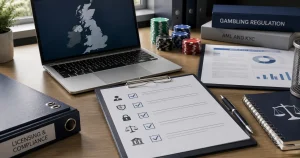


A practical guide to offshore operators, UKGC licensing, player safeguards, bonus terms and the trade-offs involved in deposits and withdrawals.
What “international casino” means for UK players
“International casino” sounds like a description of a site’s reach: a casino with customers in several countries, perhaps with a familiar-looking website and a choice of currencies. For a UK player, though, the label is less useful than one simple detail: whether the operator holds a licence from the UK Gambling Commission.
In the UK market, a foreign casino is an online gambling operator that accepts British customers without a UK Gambling Commission licence. These operators are licensed offshore, under a regulator in another jurisdiction, and are not regulated by the UK Gambling Commission. That distinction matters more than the word “international” in a site’s branding.
I used to read a licence badge as though it answered every question about a casino. It doesn’t. The badge may tell you that an operator is licensed somewhere, but it does not turn an offshore licence into a UKGC licence. Different regulator, different framework. The wording can look reassuring; the regulator named on the licence is the part worth noticing.
“International” is not a licence category
There is no special UK licence called an international casino licence. “International” is a broad, informal label, and it can describe operators with very different arrangements. A site might serve customers in multiple countries, hold a licence outside Britain, or simply use the word in its marketing. None of those details, on its own, establishes that the operator is licensed by the UK Gambling Commission.
For clarity, I would separate the terms this way:
- UKGC-licensed casino: the operator holds a licence from the UK Gambling Commission.
- Offshore casino: the operator is licensed outside the UK and does not hold a UKGC licence.
- International casino: a loose description that does not identify which regulator, if any, licenses the operator.
That last phrase is the slippery one. It sounds specific, but it doesn’t tell you where the operator is licensed or which rules govern it. If a page calls itself an international online casino, treat that as a description, not proof of its regulatory status.
What an offshore licence tells you
An offshore licence identifies a regulator outside the UK. It does not mean the casino is regulated by the UK Gambling Commission, even if the site accepts British customers or displays its licence prominently. Those are separate facts, and they should not be rolled into one claim.
When I see a licence statement, I look for the actual licensing authority rather than stopping at words such as “licensed”, “regulated” or “trusted”. The specific authority is what tells you whether the operator is offshore or UKGC-licensed. If the site’s wording leaves that unclear, the word “international” won’t clear it up.
This is not a judgement that every offshore operator is identical. It is a way of keeping the categories straight. An overseas regulator and the UK Gambling Commission are not interchangeable, and an offshore licence does not make a casino part of the UKGC system.
USA Casinos for UK Players: Licensing and Risks
Why the label can confuse
A casino may have a site in English, accept customers from Britain, and present itself as an international brand. Those features can make it feel like an ordinary UK casino at first glance. They do not tell you which regulator is responsible for its licence.
I find it helps to ask one plain question before getting distracted by the branding: does this operator hold a UK Gambling Commission licence, or is its licence offshore? That is a more useful starting point than trying to decide whether a casino looks “international” enough. The label describes an impression; the licence tells you the regulatory category.
There is another distinction worth keeping clear. A claim that an operator is licensed somewhere does not establish that it follows UKGC requirements. Offshore casinos are outside UKGC regulation, and they do not provide UKGC-mandated affordability checks. That is part of the difference between the two categories, not a small wording variation.
So when you encounter phrases such as “international casino online” or “online casino with a global reach”, translate them into something more concrete. Find out whether the operator is UKGC-licensed or offshore-licensed. If it is the latter, call it what it is: an offshore casino, not a UKGC-licensed casino wearing an international label.
Do
- Identify the actual licensing authority
- Check if the operator holds a UKGC licence
- Treat “international” as a description
Don’t
- Rely on a licence badge alone
- Assume a foreign licence is a UKGC licence
- Treat “international” as proof of regulatory status
That’s the useful distinction. The name on the banner can wait.
Recommended online casinos
- x3betBonus: Welcome Pack 100% Up to £1.000 + 200 Free Spins · Payout speed: 1-3 business days
- EvoSpinBonus: 125% up to €2500 + 125 Free Spins · Payout speed: 1-3 business days
- NightLuckBonus: Welcome Pack + 805% Up To 6400€ + 280 FS · Payout speed: 1-3 business days
- BeOnBetBonus: 100% up to €500 + 100 FS · Payout speed: 1-3 business days
- DieselwinBonus: Welcome Pack 250% up to £4000 + 200 FS · Payout speed: 1-3 business days
- JetsetspinsBonus: 200% Bonus + 100 Free Spins + Free Royal Wheel · Payout speed: 1-3 business days
- ZombillionBonus: Welcome Pack 250% up to £4000 + 200 FS · Payout speed: 1-3 business days
- AmunbetBonus: Join now and get 450% up to 2,700 GBP + 450 FS · Payout speed: 1-3 business days
- SpinFormulaBonus: 550% Up To £15,000 + 550 FS · Payout speed: 1-3 business days
- BritsinoBonus: Welcome Package – Get your £2,200 + 2,000 FS · Payout speed: 1-3 business days
The legal line: the operator’s position, not yours
The word “illegal” gets thrown around carelessly in discussions of international casino sites in the UK. I’ve seen it used as if it describes everyone involved: the company, the person placing a bet, and anyone who happens to visit the site. That blurs an important distinction. The legal position described here is not the same for the operator and the player.
A remote gambling operator offering services to customers in England, Scotland or Wales must hold a licence from the UK Gambling Commission. If it does not, it is not permitted to provide gambling facilities to customers in those countries. Advertising those services in the UK without the required licence is also illegal. The obligation sits with the company offering the gambling, not with the customer simply because they have found its website.
That remains true when a company is based abroad or holds a licence from another jurisdiction. A foreign licence is not a UKGC licence, and it does not authorise the operator to offer gambling to British customers under the UK licensing system. “International” describes where a business may be based or licensed; it does not change the requirement for a UKGC licence when the operator offers services into the British market.
Gibraltar Casino Licence in the UK: What It Means
The player’s position is different. There is no UK law that makes it illegal for an individual to place a bet with an overseas operator, and a British player does not face a criminal penalty simply for doing so. The Gambling Act does not make the act of playing at a foreign casino a criminal offence for the customer. That point can get lost when the operator’s lack of permission is described as though it automatically makes the player’s own bet unlawful.
So there are two statements that can both be true: an operator without a UKGC licence cannot legally offer gambling services to customers in England, Scotland and Wales; and a player is not committing a crime merely by placing a bet with an overseas casino. One concerns the company’s right to serve the market. The other concerns the individual’s act of betting.
That distinction is narrower than an endorsement. Saying a player is not criminally liable is not the same as saying the operator is authorised to serve them, or that the site is part of the UK-regulated gambling market. I would not read “the player isn’t breaking the law” as “this is a UK-licensed casino”. Those are separate claims.
It also helps to be precise about the phrase “international casino site”. It can describe a casino operating from outside the UK, but it does not tell you whether the operator holds a UKGC licence. If it accepts British customers without that licence, its location does not remove the licensing requirement. Nor does a licence issued elsewhere substitute for the UK one. The relevant point is not simply where the website is hosted or what country appears in its licensing information; it is whether the operator has permission to offer gambling to customers in the British market.
An operator without a UKGC licence cannot legally offer gambling services in England, Scotland, and Wales, but a British player does not face criminal penalties for placing a bet with an overseas operator.
I used to treat the legal question as a yes-or-no verdict on the whole experience: legal site, illegal site, end of story. That shortcut is neat, but it mixes up the operator’s conduct and the player’s liability. The cleaner way to put it is that an unlicensed operator is not legally entitled to provide gambling facilities to customers in the named British countries, while the player is not criminally punished just for betting with an overseas operator.
That is the legal line. Not the same thing.
Access, safeguards and the risks you take on
An international casino can appear easy to reach from Britain without being part of the system that regulates gambling here. These operators are licensed offshore, but they are not regulated by the UK Gambling Commission (UKGC). That distinction matters more than whether a website loads, lets you create an account or displays a licence badge.
Access is not a reliable sign that a site is meant to serve British customers. Gambling.com has reported that some casinos licensed outside the UK are supposed to block visitors from Britain, yet do not consistently enforce that restriction; the report also says a basic VPN can get around a block. That is a report about access, not a guarantee that any particular site will accept you or let you keep an account. A site’s position can change, and getting through a registration screen tells you little about what protections apply afterwards.
Non-GamStop European Casinos: UK Rules Explained
I’d be wary of treating a working website as a green light. If you are looking at international casino sites for UK players, separate the practical question — can I open the site? — from the more important one: what happens if something goes wrong? With an offshore operator, UKGC oversight does not sit behind your account. The operator may have a licence elsewhere, but that is not the same as being regulated by the UKGC, and its safeguards should not be assumed to match those required of a UK-licensed casino.
That difference is particularly serious around gambling controls. UKGC-licensed operators are covered by GamStop. If you register for self-exclusion through GamStop, you are locked out of every UK-licensed gambling site. A foreign casino operating beyond the UKGC’s remit is not covered by that scheme, so GamStop cannot block access to it.
That gap can matter at exactly the wrong moment. A specialist review has described how someone who has self-excluded through GamStop may be able to register with a foreign casino and deposit without the safeguards attached to UK-licensed sites. The point is not that every registration will happen instantly, or that every operator handles accounts the same way. It is that GamStop does not extend its protection to these sites. If you have self-excluded because gambling has become difficult to control, an accessible alternative is not a harmless workaround. It can undo the barrier you put in place.
There is another important difference: offshore operators do not have to provide the UKGC-mandated affordability checks that apply within the British regulatory system. That does not mean a particular foreign casino will have no checks of its own. It means you should not assume that UK requirements apply, or that the controls you expect from a UK-licensed operator will be there. A polished website, a stated offshore licence or reassuring language about responsible gambling does not establish equivalent protection.
Gambling Controls
Offshore casinos are not covered by GamStop, meaning self-exclusion through the scheme cannot block your access to these sites.
The hardest risk to shrug off is a disputed payout. Gambling.com has reported cases in which unlicensed sites refused to pay customers’ winnings, leaving those customers without legal recourse. That is a reported risk, not a claim that every offshore casino behaves this way. But when you use a site outside UKGC regulation, you cannot count on the same UK regulatory route if a dispute arises. A support chat or complaint form may exist; neither is a substitute for UKGC oversight.
I have learned not to let the word “licensed” do all the thinking for me. A licence can identify the regulator a site answers to, but it does not make that regulator the UKGC, nor does it guarantee that you will have the same protections or routes for help as you would at a UK-licensed operator. Read the site’s terms and understand who regulates it before depositing. And if you are already relying on GamStop, do not treat non-GamStop casinos as a safe way around your exclusion.
The practical choice is less about whether a casino is reachable and more about what you give up by using it. A foreign site may be visible to British visitors, but access is not endorsement, and an offshore licence is not UK regulation. Keep that distinction in view before an account is opened, not after a problem starts.
Bonus maths: the number behind “free”
A bonus headline is not cash in your account. It is an offer with conditions attached, and the wagering requirement is the part that tells you how much qualifying betting stands between the bonus and a possible withdrawal. I used to look at the big number first. Better to start with the small print.
A specialist review describes larger welcome packages at foreign casinos as a consequence of operators not being bound by UKGC restrictions on bonus terms, wagering requirements and promotional language. That is a description of the promotion, not a reason to treat it as better value. Non-GamStop casinos operating outside the UKGC system are not subject to UKGC oversight, and they do not provide UKGC-mandated affordability checks. A generous headline does not make those protections appear.
The formats behind the headline
Specialist casino reviews commonly group promotions into a few broad formats:
- Deposit matches add bonus funds in relation to a deposit. The headline match is only one part of the calculation: the wagering requirement determines how much qualifying betting is required before the bonus can become withdrawable.
- Free spins provide spins under stated conditions. Check whether any winnings are bonus funds, what wagering applies to them, and whether the offer sets other restrictions.
- No-deposit bonuses do not require a deposit to claim, but “no deposit” does not mean “no conditions”. Read the claim rules and the withdrawal terms before counting any winnings as yours.
- Cashback returns some amount according to the offer’s terms. Check what activity it covers and whether the cashback itself has to be wagered.
Those are categories, not promises that every site offers them or applies identical rules. An international casino welcome bonus can combine features, too, so read the full terms rather than judging it by the banner. The same goes for free spins without a deposit: the phrase describes how the offer begins, not what you can necessarily withdraw.
Turn the multiple into money
The arithmetic is straightforward once you know which amount the wagering requirement applies to. A specialist review gives this example: a £20 bonus with a 35x requirement calls for £700 in qualifying bets before you can cash out. That is betting turnover, not a requirement to lose £700, but it is still a substantial amount of play to clear a bonus.
The base matters. If a 100% match gives you a £100 bonus and the 35x requirement applies to the bonus alone, the same kind of calculation means £3,500 in bets before the bonus funds become withdrawable. Do not assume every offer calculates wagering on the bonus alone: the terms need to say whether it applies to the bonus, the deposit, or both. That one detail can change the total sharply.
Bonus Turnover Calculation
Step 1: Identify the bonus amount
Take a £20 bonus as an example.
Step 2: Locate the wagering requirement
Find the multiplier in the terms, such as a 35x requirement.
Step 3: Calculate total bets
Multiply the bonus by the requirement (£20 × 35) to find the £700 in qualifying bets needed before cashing out.
And turnover is not a prediction of what you will have left. Bets can lose while you work through the requirement. Treating the bonus as guaranteed extra money is the mistake. It isn’t.
What I check before accepting
I look for the wagering base, which games count, any maximum bet while wagering, and any time limit or cap on winnings. These are terms to verify, not conditions I’d assume are the same across casinos. If the wording is unclear, the advertised value is unclear too.
A no-deposit offer may sound like a risk-free test, but claiming it can still mean accepting rules that affect whether winnings are withdrawable. An offer linked to an international bitcoin casino is no different in that respect: the currency label does not explain the bonus maths. Keep the promotion and the payment method separate in your thinking.
My rule now is plain: calculate the required turnover before deciding whether a bonus is worth taking. If the terms do not make the calculation clear, I move on. The headline can wait.
Live roulette: check the details before you play
A live roulette page can look polished, but the presentation tells you little about who is taking your bet. Before you sit down, check the operator behind the site, not just the table graphics or the word “international” in its branding.
For a British player, the key distinction is whether the operator holds a UK Gambling Commission licence. A casino licensed offshore is not regulated by the UKGC, and an offshore licence does not authorise the operator to offer gambling in Britain. That matters if you expect British rules and protections to apply. They do not.
I’ve learned not to treat a licence badge as decoration. Find out which company runs the casino and which authority, if any, licenses it. Read the licence information on the operator’s own pages, and see whether the company name matches the one in its terms. If those details are hard to locate or do not line up, I would not assume the site is accountable just because the roulette lobby looks professional.
Before Playing Live Roulette
- Verify the company running the casino
- Confirm the licensing authority
- Match the company name with the terms
- Review specific table rules and limits
- Check the operator’s complaints procedure
Then check the rules for the specific table before placing a bet. Look for the stated game rules, available betting options and any table limits. Do not assume that a familiar-looking layout means the rules or conditions are the same as elsewhere. If the site does not explain them clearly, that is a reason to pause.
Also read the operator’s terms and its information on complaints. An offshore casino does not fall under UKGC oversight, so you should not expect UKGC enforcement or the same dispute protections as at a UK-licensed operator. A specialist review may describe a site as “secure”; that is not proof of UKGC regulation, nor does it establish what would happen if you disagreed with a decision.
The same caution applies on a phone. A mobile-friendly live casino is still run by the same operator, under the same licensing arrangements. A smooth screen does not make the site more accountable.
Finally, remember what is absent: offshore operators do not offer UKGC-mandated affordability checks. If gambling is becoming difficult to control, an offshore site is not a safer workaround. Non-GamStop casinos sit outside GamStop, too, so that self-exclusion scheme does not cover them.
Check the operator first. Then decide whether the table is worth your trust.
Real-money play and getting your money out
When you’re choosing an international casino for real-money play, the cashier matters less for how polished it looks than for what happens when you request a withdrawal. A deposit can appear straightforward; getting the balance back depends on the payment route and the operator’s own processing rules.
E-wallets are generally the quickest option on the UK market: most operators process withdrawals to them within 24 hours. For foreign casinos, Skrill and Neteller withdrawals are also reported as clearing within 24 hours, with many handled in under 12. That is a stated processing window, not a promise that every request will arrive by then. The casino may still need to review and approve a withdrawal before the payment provider receives it.
Bank transfers tend to take longer. A specialist review reports that they can take five to seven business days, and that some foreign casinos add an internal wait before sending the money. So the banking timeline may not start when you click “withdraw”. Check the casino’s terms for its processing stage and any pending period, rather than relying on a headline claim about transfer speed.
Crypto is sometimes described as quicker still: a specialist review reports withdrawals clearing in under an hour. But that speed comes with a trade-off: the value of the currency can move while you hold it. Crypto is a separate choice from a bank transfer or e-wallet, not a way to remove uncertainty from the cash-out process.
I learned to look at the whole route, not just the method shown beside a deposit button. Check that the withdrawal method is available for your account, what verification the operator may request, and whether limits or pending periods apply. These rules vary considerably between operators, so one casino’s timeline tells you little about another’s. Keep a copy of the terms you relied on and the confirmation of your request; if a payment is delayed, you will at least have a clear record of what was stated.
E-wallets
Processing often within 24 hours; Skrill and Neteller are reported to clear in under 12 to 24 hours.
Bank Transfers
Typically take five to seven business days, potentially including an internal casino wait period.
Crypto
Can clear in under an hour, though value may fluctuate during the transaction.
That’s the unglamorous bit. A “fast payout” label is only useful when the rules explain what fast means, and when the clock actually starts.
Reading casino reviews without swallowing the pitch
I’ve learned to read a casino review with one eye on the claims and the other on who might benefit from them. “Best” can mean a careful comparison, but it can also be a sales label. A page can describe an international casino in glowing terms and still leave out the detail that would change how you judge it.
That detail is sometimes a commercial connection. Santeda, for instance, had a contract under which SIS received a percentage of revenue from losing bets placed through Santeda’s brands. That is worth knowing when assessing how companies in the gambling industry relate to one another. It does not, by itself, prove that a particular review is biased or that the arrangement affected what a reviewer wrote. It does give you a reason to look for clear disclosure rather than treating every confident recommendation as independent.
I also check whether a review separates verifiable information from sales language. Does it identify who operates the casino and explain the licence accurately, or does it use “trusted” as if that word settled the question? Santeda’s Curaçao licence does not authorise it to operate in the UK or the US. Offshore casinos are not regulated by the UK Gambling Commission, and they do not provide UKGC-mandated affordability checks. A review should not blur those distinctions behind a reassuring badge or broad claims about safety.
The same scepticism applies to an international casino real-money review: praise is not evidence that a payout, account decision or complaint will go your way. If the page gives no basis for its judgement, treat the judgement as an opinion. I’d rather see a review state what it has actually checked, and what it has not, than dress an advert up as certainty.
That goes for roulette-focused reviews too. A polished page about an international roulette casino is still not proof of the operator’s standards or of the reviewer’s independence. Look for named relationships and precise language, then make your own call. Less glitter. More disclosure.
Casino apps: security claims need context
An international casino app can look polished and still leave important questions unanswered. I’ve learned not to treat a padlock graphic or the word “secure” as a substitute for checking who runs the service and which regulator oversees it.
Some specialist casino reviews describe non-GamStop casinos as using advanced encryption to protect personal and financial information. Encryption can help protect data in transit, but that claim alone does not tell you how an app handles information more broadly, or what happens if there is a dispute. Read the privacy and security explanations in the app or on the operator’s site, and make sure you know which company is responsible for the account.
The key distinction is regulatory. These casinos are licensed offshore and are not regulated by the UK Gambling Commission. A statement that an operator is licensed somewhere else does not make it subject to UKGC rules or give it UKGC oversight. Nor should broad assurances about security be taken to mean that UK-mandated affordability checks apply: offshore operators do not offer those checks as required by the UKGC.
Attention: Advanced encryption protects data in transit but does not provide UKGC oversight or mandated affordability checks.
Before installing anything, check that the app is presented by the operator itself, rather than relying on a lookalike listing or a link in an advert. Review what permissions it requests and avoid entering account details if the publisher or destination is unclear. Those checks can help you make a more informed choice; they cannot turn an offshore app into a UKGC-regulated one.
That distinction matters more than the interface. A slick app is still just the front door.
Casino games and the limits of what can be verified
A games page can make an international casino sound like a guaranteed match for your tastes. I’ve learned to treat a broad catalogue claim as a starting point, not proof that a particular game is available, works as described or can be played under the terms you expect. Without checking the individual operator and its current offering, naming titles would be guesswork.
That matters because “international games” is not a useful quality test by itself. A list on a promotional page does not tell you whether the games are actually accessible to you, what rules apply or whether the description is current. Look for clear, operator-specific information rather than relying on sweeping claims. Still, that does not make an offshore site equivalent to one regulated by the UK Gambling Commission: offshore casinos sit outside UKGC oversight, and they do not provide UKGC-mandated affordability checks.
There is one concrete British rule worth keeping in view if you are comparing online slots. Autoplay is banned in Britain, and each slot spin must take at least 2.5 seconds. A site’s description of its games does not, by itself, establish how its service fits with British requirements.
I wouldn’t take a polished games page as evidence that every named category has been checked or is available to British visitors. Verify the terms and the operator’s information before putting money in. “Huge choice” is marketing, not a guarantee.
Offshore casinos for UK players: risks and checks
Crypto deposits and the withdrawal trade-off
Crypto can make an international casino feel simple at the deposit stage: choose a supported coin, send it to the address shown, and wait for the transaction to be credited. But “simple” is not the same as reversible. A transfer sent to the wrong address may be difficult or impossible to recover, so check the currency and network carefully before confirming. The casino’s own instructions matter; do not assume a wallet will accept every asset or network.
The tempting part is the withdrawal claim. A specialist review reports that crypto withdrawals at foreign casinos can clear in under an hour, faster than fiat methods. Treat that as a reported possibility, not a promise about every operator or every request. A casino may still have its own review and processing steps, and the time taken for a transfer to appear can also depend on the network. Read the withdrawal terms before depositing, including any stated minimums, fees, and conditions for sending funds back to you.
Then there is the value swing. Crypto can be worth less by the time you receive it or convert it, so a quick withdrawal does not guarantee that you retain the same value you deposited or won. That trade-off is easy to overlook when the headline is about speed. I would judge the offer by the amount you can actually use after conversion, not just by the number of minutes claimed.
One point matters more than the payment technology: a foreign casino is outside UK Gambling Commission regulation. It does not provide UKGC-mandated affordability checks, and crypto does not change that. If you choose to deposit, keep the amount within what you can afford to lose and retain your transaction records. Fast is not the same as safe.
Is playing at an international casino legal for UK residents?
Yes, placing a bet with an overseas casino is not illegal for you. However, an operator without a UK Gambling Commission licence is not permitted to offer gambling to customers in England, Scotland or Wales.
What should players check to assess whether an international casino is safe?
Check which regulator issued the casino’s licence; an offshore licence is not a UK Gambling Commission licence. Also consider that unlicensed sites have sometimes withheld winnings, leaving players with no legal recourse.
Can I play at a casino licensed outside the UK?
Yes, playing at an overseas-licensed casino is not illegal for you as a British player. The foreign licence does not permit the operator to offer gambling to customers in England, Scotland or Wales without a UK Gambling Commission licence.
Are foreign casinos safe for UK players to use?
Not necessarily: foreign casinos are outside UK Gambling Commission regulation, and some unlicensed sites have refused to pay winnings, leaving customers with no legal recourse. Check the named regulator and understand that an offshore licence does not provide UKGC protections.
Is it legal for UK residents to use casino sites that operate outside the UK’s licensing framework?
Yes, there is no UK law prohibiting you from placing bets with an overseas operator. It is the operator—not the player—that acts unlawfully by offering gambling to customers in England, Scotland or Wales without a UK Gambling Commission licence.
Are winnings from foreign casinos taxable in the UK?
No. Gambling winnings are not subject to UK income tax, whether the casino is UKGC-licensed or not.
Can I use cryptocurrency at foreign casinos from the UK?
Yes, some foreign casinos offer crypto payment options. Crypto withdrawals can clear in under an hour, but the value can fluctuate.
What is the fastest way to withdraw from an online casino in the UK?
E-wallets are consistently the fastest option on the UK market, with most operators processing withdrawals within 24 hours. At foreign casinos, crypto withdrawals can clear in under an hour, though their value may fluctuate.
Material created by the team Basswin UK Guide