

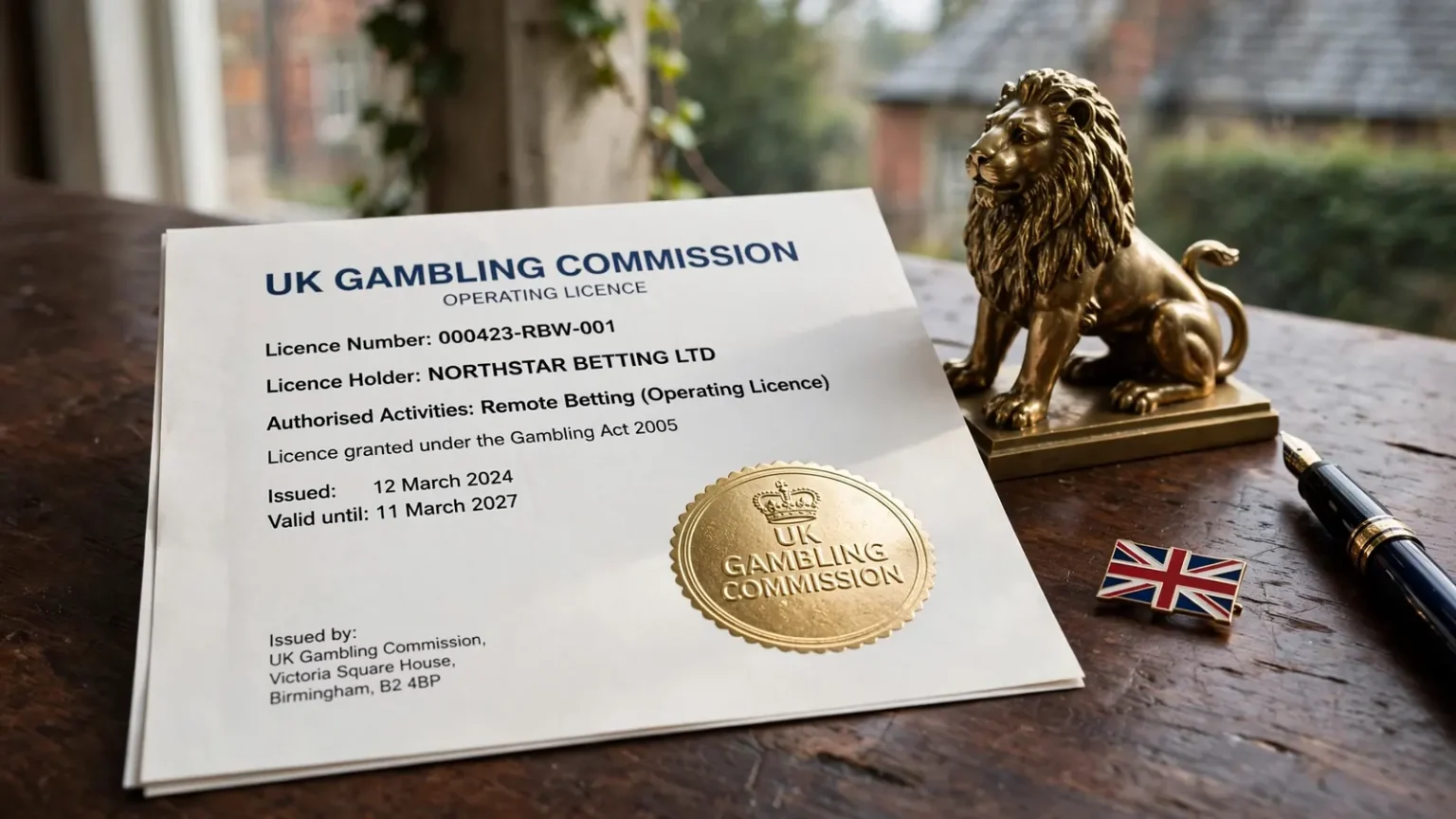
A practical look at licensing, account checks, withdrawals, reviews and terms, including what non-GAMSTOP and crypto labels do—and do not—mean.
What a UK Casino Licence Actually Tells You
When I see a casino described as “trustworthy”, I want to know what that word rests on. A polished site and reassuring copy can tell you how an operator wants to be seen. A UKGC Licence tells you something more concrete: the business has the authorisation required to offer remote gambling to consumers in Great Britain under the UK Gambling Commission’s regime.
That is the starting point, not a medal for being the nicest casino around. The licence answers a legal question about permission to operate. It does not, by itself, settle every question you might have about an operator or prove that every experience will go smoothly. I learned to separate those ideas after treating a confident-looking website as if appearance were evidence. It isn’t.
The rule follows the customer
For remote gambling, the operator’s location does not remove the licensing requirement. A business based outside Great Britain still needs the relevant UK Gambling Commission licence if it offers gambling facilities to people here. The important point is not the address the company puts on its website; it is whether it is offering remote gambling into the market covered by the Commission.
Offshore Casino Sites in the UK: Risks and Terms
That distinction matters because online services can look detached from geography. You can open a site from a phone or laptop without seeing where the business is based, and the branding may make the operation feel local even when it is not. But a foreign base is not, on its own, an alternative to UK permission. If the business is serving consumers in Great Britain, the licensing baseline still applies.
In practical terms, I would not treat “available to me” and “authorised to serve me” as interchangeable. A site appearing on your screen does not establish that it is operating within the British regulatory system. Nor does a statement about a licence in another place answer whether it has the authorisation required here. The local question is the relevant one.
That is the difference between access and status. A service can be reachable online; that alone does not tell you what rules govern its offer to British customers.
What the licence establishes
A UKGC Licence establishes that the operator has the required permission for the relevant remote gambling activity offered to consumers in Great Britain. It places the operation within the UK Gambling Commission’s regulatory framework. That is a meaningful baseline: legal permission is not a decorative feature, and “trustworthy” should not be used to blur the distinction between a licensed operator and one without the required local authorisation.
No Account Casinos in the UK: Checks and Licensing
I think of it as the first threshold, not a complete personal recommendation. If an operator has no relevant UKGC Licence, it does not meet the licensing baseline for offering remote gambling to people in Great Britain. If it has one, the legal question is answered in the other direction: it has permission under this regime. Neither statement tells you everything you may want to know before deciding whether to use the service.
That sounds obvious, but advertising often compresses different claims into one warm phrase. “Safe”, “trusted” and “premium” can be made to sound as though they are official findings. They are not the same thing as a UKGC Licence. I now try to translate the language back into plain terms: what is the operator actually authorised to do, and for which market?
There is a practical discipline in that. Start with the licence question, then keep any broader judgement separate. A licensing baseline can rule out a basic concern about whether the operator has the required British permission. It cannot turn every other impression into a verified fact.
The boundary is Great Britain
There is an important geographic limit to keep clear. The Gambling Commission’s remit under the Gambling Act 2005 covers Great Britain: England, Scotland and Wales. Northern Ireland is not covered by that Commission’s remote-gambling remit in the same way.
I would be careful with casual phrases such as “UK-licensed” when they are used as if every part of the United Kingdom sits within one identical regulatory arrangement. The UK Gambling Commission’s role described here is tied to Great Britain. Northern Ireland has a different legal context, so a statement about the Commission’s authority in Great Britain should not be stretched into a claim that it regulates remote gambling there on the same basis.
Geographic Limit
The Gambling Commission’s remit covers Great Britain (England, Scotland, and Wales), but does not cover Northern Ireland in the same way.
This boundary is easy to miss because operators and readers may use “UK” as a shorthand for the whole country. In a conversation, that can be convenient. When you are trying to understand who regulates an online gambling offer, precision matters more than shorthand. The relevant question is whether the offer is being made to consumers in Great Britain, or whether you are asking about Northern Ireland.
It also explains why the phrase “a UKGC Licence” is more useful than a vague assurance that a casino is “regulated”. It points to a particular regulator and a particular jurisdiction. That does not make every other use of the word “regulated” false, but it does mean the wording alone is not enough to establish that the operator has permission to serve Great Britain.
What it does not tell you
A licence should not be read as a guarantee that you will never have a disagreement, that every decision will feel fair, or that you personally will like the way a site works. It establishes regulatory permission; it is not a promise about your individual outcome. I made the mistake of letting the word “licensed” do too much work in my head. It answered one important question, then I acted as if it had answered all the others.
That is not a reason to dismiss licensing. Quite the opposite. The baseline matters because it separates an operator authorised for the British market from one that is not. But “most trustworthy” is a wider judgement than “has the required licence”. The first phrase can imply a comparison of conduct, service and experience; the second identifies a legal status. Keeping those meanings apart helps you avoid being nudged by a confident slogan.
Merkur Casino Online UK: Games, Bonuses and Checks
The same goes for lists that call themselves a list of trustworthy online casinos. A list may be a useful place to begin reading, but the label itself does not establish the licensing position. The word “trustworthy” is an assessment, not a regulator’s stamp. I would rather see the underlying claim stated plainly than have a broad compliment stand in for the detail.
And the licence is about the operator’s permission, not a guarantee attached to each game or each session. Searching for trustworthy casino sites or trustworthy online slots can make it sound as if trust is a property of the page or the game title. The licensing question sits at the level of the business offering remote gambling to consumers in Great Britain. It does not turn a game into a separate licensed operator.
A useful first question, not the last word
When someone asks what makes online casinos trustworthy, I would begin with the legal baseline: does the operator have the relevant UKGC Licence to offer remote gambling to consumers in Great Britain? If the answer is no, the operator does not meet that requirement for this market. If the answer is yes, you have established an important starting point, but not a complete verdict on everything that follows.
That is a less exciting answer than a neat “best” label. It is also more useful. I have spent money after mistaking polished presentation for proof, and I know how tempting it is to skip the dull question when the site is already inviting you to sign up. The dull question comes first.
Licensing Baseline
Verify if the operator has a UKGC Licence first, then keep any broader judgements about trust separate.
One boundary, one baseline.
A Licence Is Not the Whole Trust Story
A UKGC Licence is a necessary starting point, but it does not tell you everything about the business behind a casino or how that business has behaved. I used to treat the licence badge as the answer: if it was there, I stopped asking questions. That was too quick. A badge is a claim on a webpage; the public register gives you a way to check which operator and account sit behind a domain.
That distinction matters because the name on the casino’s front page may not be the name of the licensed operator. A domain can be connected to a business operating under a white-label arrangement. The relationship does not, by itself, prove that anything is wrong. It does mean that you should identify the accountable operator rather than assume the brand name tells the whole story.
The Gambling Commission’s register links 333casino.com to Grace Media (Gibraltar) Limited, under account 57869, and identifies the domain as a White Label domain. That is a concrete detail a reader can verify in the register. It tells you who the Commission associates with that domain; it does not mean the domain is itself a separate operator or that the register entry is an endorsement of every aspect of the customer experience.
That last point is easy to miss. A regulatory entry is evidence of a relationship and status, not a promise that you will never have a complaint, a confusing interaction or a reason to contact the operator. I would treat the register as a starting point for accountability: it helps answer who is responsible, so you have something more solid than a logo or a marketing name.
Casino without a Swedish licence: UK guide
Then look at what the regulator has done. On 26 June 2025, the Gambling Commission imposed a £60,000 financial penalty on Grace Media. The breaches involved self-exclusion and consent for direct electronic marketing. That is relevant when assessing the operator’s record because the issues concern safeguards and whether marketing messages were sent with the required consent.
It would be a mistake to stretch that fact further than it goes. The penalty does not establish that every player at every Grace Media domain had the same experience, and it is not evidence that a particular customer’s account was handled badly. It is, however, a public regulatory action against the company linked to the 333casino.com register entry. If I were checking that domain, I would want to know both things: who the register connects it to, and what enforcement history is recorded for that operator.
This is why a trust check needs more than a quick look at a licence badge. First, match the casino domain to the operator named in the register. Then check the account information and note whether the register describes the relationship as a white-label domain. Finally, look for published regulatory action involving that operator. Keep the details together; searching a brand name alone can leave you with fragments that are hard to connect.
If the names do not match, do not assume that means the casino is unlicensed. A brand and its operating company can be different names. But do not wave away the difference either. You need to understand which company carries the regulatory responsibility. A clear link in the register is more useful than a vague assurance from a promotional page.
Trust Check Process
Match the domain
Identify the casino domain and match it to the operator named in the public register.
Verify accountability
Check the account information and note if the register describes the relationship as a white-label domain.
Review regulatory action
Search for any published regulatory actions or penalties involving that specific operator.
Regulatory action also needs context. A penalty is not a full report card, and the absence of a penalty you happen to find is not proof that an operator is flawless. What it gives you is a documented event to weigh alongside the register entry. In Grace Media’s case, the stated issues involved self-exclusion and marketing consent, so they are not abstract paperwork matters. They touch controls that should help people manage contact and gambling.
I find it useful to separate three questions: Is the domain linked to a licensed operator? Which operator is accountable for it? Has the regulator published action that changes how I view that operator’s record? A casino can answer the first question and still leave the other two worth checking. That is not cynicism. It is basic due diligence.
There is no magic “trustworthy” stamp that removes the need to read the details. The register can identify the company; enforcement records can show where the regulator has intervened. Neither guarantees a trouble-free account, but together they give you a more grounded picture than the casino’s own claims. Start with names and evidence. Not slogans.
Recommended online casinos
- x3betBonus: Welcome Pack 100% Up to £1.000 + 200 Free Spins · Payout speed: 1-3 business days
- EvoSpinBonus: 125% up to €2500 + 125 Free Spins · Payout speed: 1-3 business days
- NightLuckBonus: Welcome Pack + 805% Up To 6400€ + 280 FS · Payout speed: 1-3 business days
- BeOnBetBonus: 100% up to €500 + 100 FS · Payout speed: 1-3 business days
- DieselwinBonus: Welcome Pack 250% up to £4000 + 200 FS · Payout speed: 1-3 business days
- JetsetspinsBonus: 200% Bonus + 100 Free Spins + Free Royal Wheel · Payout speed: 1-3 business days
- ZombillionBonus: Welcome Pack 250% up to £4000 + 200 FS · Payout speed: 1-3 business days
- AmunbetBonus: Join now and get 450% up to 2,700 GBP + 450 FS · Payout speed: 1-3 business days
- SpinFormulaBonus: 550% Up To £15,000 + 550 FS · Payout speed: 1-3 business days
- BritsinoBonus: Welcome Package – Get your £2,200 + 2,000 FS · Payout speed: 1-3 business days
Real-Money Play: Verification and Getting Your Money Out
The point where real-money play begins is not your first spin. It is the account check that comes before it. In Britain, an operator must verify your identity before allowing you to deposit or play. That can feel like a tedious hurdle, but it is better to know about it before you have money tied up in an account.
UK Online Casino Payouts: What RTP Really Means
Identity checks commonly involve a photo of your passport or driving licence and a recent utility bill. Keep the images clear and make sure the information can be read. If the operator asks for more, follow the instructions through its account area rather than sending personal documents in response to an unexpected message. I used to treat these checks as an annoying last-minute task. Bad plan.
There can still be identity or payment-ownership questions later, particularly when you ask to withdraw. A first withdrawal may involve document checks that add time. One specialist review reports an additional 12–24 hours for this step; treat that as a reported estimate, not a promise that every operator will follow the same timetable. If the account is already verified, you may avoid that particular delay, but don’t assume it means a withdrawal will reach your bank immediately.
The operator’s review and the payment provider’s processing are separate parts of the wait. A specialist review puts debit-card withdrawals at 2–3 banking days after the operator has reviewed the request. That detail matters: the clock described there begins after the operator’s review, not necessarily when you first click “withdraw”. A weekend or a pending check can make the whole experience feel longer than the advertised processing time suggests.
Bank transfers can come with a charge from your bank. A specialist review reports fees of £2–£5, depending on the bank’s policy. Check your own account terms before choosing a transfer; don’t assume the casino is charging you just because a fee appears. Small costs have a way of being easy to miss until the money arrives.
Do
- Check withdrawal methods and processing stages
- Ask support for clarification before depositing
- Keep a record of withdrawal requests
Don’t
- Assume a deposit option implies a withdrawal option
- Rely on claims of “instant” payouts
- Guess delivery dates for your funds
Before depositing, look at the cashier’s information for both directions of travel. Deposit and withdrawal availability are separate, so seeing a payment option for adding money does not, by itself, tell you how you can cash out. Check the withdrawal methods, any stated processing stages and whether the operator requires documents before approving a request. If the information is unclear, ask support before putting money in.
I’d also keep a record of the withdrawal request and any messages about it. If a check is pending, ask what is outstanding and whether the operator needs anything from you. That is more useful than repeatedly submitting the same request or guessing at a delivery date.
A trustworthy real-money casino is not one that claims payouts are “instant”. The useful detail is what happens at each stage: what identity documents are needed, when the operator reviews a withdrawal, how the chosen payment method is processed, and whether your bank may charge for a transfer. Read those details before you deposit, not when you are waiting for your balance to reach you. Plain, specific answers beat a shiny promise.
Reading Casino Reviews Without Taking Their Word for It
A casino review can sound careful and still leave you with nothing you can verify. I used to treat a confident tone as a sign that somebody had done the homework. It isn’t. A useful review should give you claims you can check against information published by the operator or a public authority, not just a string of reassuring adjectives.
UK mobile casinos: paying by phone credit
When I read one now, I separate its conclusions from its evidence. “Trustworthy” is a judgement; an operator name, account number or domain is something you can compare with a public record. If the review says a casino is authorised for customers in Great Britain, it should identify the business responsible for the site and make it possible to check that business against the Gambling Commission’s register. If it cannot tell you who operates the casino, the praise is hard to assess.
That does not mean a register entry proves every claim in a review. It confirms particular details: for example, which operator is listed and which domain is associated with it. It does not tell you whether a reviewer has tested customer service, whether a bonus is worthwhile or how a particular account issue was handled. Those are separate claims, and they need their own evidence.
Follow the operator, not just the brand
LeoVegas is a useful example of how to follow the trail. The Gambling Commission’s public register lists LeoVegas Gaming PLC under operator account number 39198. Its domain register identifies leovegas.co.uk as the active UK-facing domain linked to that same account.
That gives you a simple cross-check: the company name, account number and domain should tell a coherent story. A review that names LeoVegas can be compared with those public entries rather than accepted on the strength of its logo or tone. If a review gives different operator details, or says nothing about who runs the site, pause and find out why before relying on its other conclusions.
Cross-Checking LeoVegas
To verify LeoVegas, match the brand to LeoVegas Gaming PLC (account 39198) and the active domain leovegas.co.uk in the Gambling Commission’s register.
The match between a brand and an operator can be easy to miss. Review pages may foreground the casino name, while legal or register information uses a company name. I’ve overlooked that distinction before and assumed the brand itself was the whole business. It isn’t. Check the name the review gives against the regulator’s operator entry, then check whether the domain you are considering is the one connected to it.
Be precise about what the match establishes. It supports the claim that the domain is associated with the listed operator in the register. It is not a personal endorsement from the regulator, and it does not make every sentence in a review reliable. One confirmed detail is useful. It is not a blank cheque.
Look for evidence behind the verdict
A review becomes more useful when it explains how it reached a judgement. Does it identify the operator? Does it distinguish facts it checked from opinions based on the reviewer’s experience? Does it explain what a positive or negative finding actually means for you? A conclusion without a visible trail asks you to borrow someone else’s confidence.
I also watch for praise that changes shape when you inspect it. “Fast payouts” is not very informative unless the review explains what it means and what it observed. “Great support” is similarly thin without an account of how support was tested. The point is not to demand a laboratory report from every reviewer. It is to see whether the evidence is specific enough to judge, and whether the wording promises more than that evidence can support.
Affiliate links are another reason to read with your eyes open. A review may earn money if you sign up through it. That does not automatically make its facts false, but it gives you a reason to verify important claims independently and to treat rankings and glowing labels as opinions, not findings.
Offshore casinos for UK players: risks and checks
I’ve been caught by the polished version: a tidy score, a few impressive claims and no clear route back to the underlying information. Now I look for the checkable details first. Small habit. Big difference.
Trustworthy casino reviews should help you investigate, not ask you to hand over your judgement. Compare the named operator and domain with the public register, then keep separate the facts the register can confirm from the reviewer’s experience and opinion. If those pieces are muddled together, the review may still be readable, but it has not done the checking for you.
Before You Sign Up, Check the Small Print
I used to read the headline offer and treat the conditions as a detail for later. That was backwards. Before creating an account, open the full promotion terms and check what you must do to qualify, what counts towards wagering, and when the offer ends.
A specialist affiliate review describes welcome deals as often restricted to new customers, limited to one per household, and unavailable with some payment methods, including certain e-wallets. Those conditions can make an offer irrelevant to you before you have even started. Check the casino’s own current terms rather than assuming a summary covers every restriction.
The wagering figure needs translating into actual stakes. A £20 bonus with a 10x wagering requirement means £200 in total bets before the requirement is met. That is turnover, not a promise that you will finish with £20—or any particular balance. I find it clearer to work out the required stakes first, then decide whether the offer is worth the strings attached.
Bonus Terms Check
- Read full promotion terms before creating an account
- Calculate total stakes required by the wagering requirement
- Check contribution rules for specific games
- Verify the expiry date for bonus funds and free spins
Look for the contribution rules too. A game may count fully, partly or not at all towards wagering, depending on the terms. A specialist review says slots commonly count in full, while live tables and blackjack may count less or be excluded. Verify the specific promotion: playing a game that contributes nothing can leave the requirement unchanged.
Expiry is another easy detail to miss. One specialist affiliate review puts bonus funds and free spins within a 7-to-30-day expiry range, but the offer you are considering may set a different period. Check when the clock starts and whether unused bonus funds or spins disappear at the deadline. “Free” has an end date.
Finally, treat account setup as part of the decision, not an obstacle to deal with after depositing. UK rules require verification before you can deposit or play, so be ready to provide identity information when registering. If the details you enter do not match your documents, an attractive offer will not fix that.
I now read the terms before I click claim. Not glamorous. Much cheaper than guessing.
Non-GAMSTOP Casinos and the Limits of That Label
“Non-GAMSTOP” can sound like a feature: a casino with fewer barriers, perhaps even a more welcoming one. I’d read it differently. For people in Great Britain, the key question is whether the operator is inside the Gambling Commission’s regime. Online operators regulated by the Commission must take part in GAMSTOP, and that requirement became compulsory on 31 March 2020.
So a site presenting itself as non-GAMSTOP is not offering a special kind of UKGC-regulated account that simply skips the scheme. The label points to a meaningful distinction: the operator may be outside the system that requires participation. It does not, on its own, tell you that the casino is trustworthy, fair or accountable to British players.
That distinction matters most if you have chosen self-exclusion. I would not treat a non-GAMSTOP offer as a workaround or as a sign that the restriction no longer matters. Self-exclusion is there to help create distance from gambling; seeking out a site because it does not apply that block can undermine the boundary you set for yourself. Pause before depositing, and consider talking to someone you trust.
The label can also blur the difference between a marketing claim and regulatory status. A polished site, familiar payment logos or friendly support chat cannot establish that an operator belongs to the UKGC regime. Nor does the phrase “trustworthy non-GAMSTOP casino” resolve the contradiction: trust needs evidence, while the label itself says nothing about the safeguards attached to a UKGC-regulated operator.
If gambling is becoming difficult to control, you can contact the National Gambling Helpline on 0808 8020 133. It is available around the clock. Asking for support is not a failure, and you do not have to wait until things feel completely out of hand.
I know the appeal of looking for an exception when a limit feels inconvenient. But a label that promises fewer protections is not proof of a better experience. Treat it as a reason to stop and think, not as a recommendation.
Self-Exclusion Risk
Seeking out non-GAMSTOP sites to bypass self-exclusion can undermine the boundaries you set for your own protection.
Bitcoin and Ethereum Do Not Replace a Licence Check
I used to treat a payment option as a kind of trust badge. If a casino accepted Bitcoin or Ethereum, I assumed it had made an effort to look modern and knew what it was doing. That was a poor shortcut. A way to pay tells you how a transaction might be made; it does not tell you whether the business is authorised to offer gambling to people in Great Britain.
That distinction matters whether you are looking at a Bitcoin casino or one advertising Ethereum payments. The coin named on a page can catch your eye, but it cannot stand in for the operator’s UKGC Licence. If the casino offers remote gambling to customers in Great Britain, the relevant Gambling Commission licence is required even when the company is based somewhere else. The company’s location does not change that requirement.
Different question. Different evidence.
Start with the operator, not the coin
When I’m checking a casino now, I try to separate the payment question from the permission question. First, find out which business operates the site. Then check that business and the casino’s domain against the UK Gambling Commission’s public register. The name on a payment page or in a promotional description is not necessarily enough to identify the operator, so don’t stop at the brand.
A crypto logo is easy to display. It does not show that the operator holds the authorisation needed to serve Great Britain. Nor does it establish that the business named in an advert is the same one responsible for the casino account. Those are separate things to verify.
If the site does not make the operating company clear, that is a reason to pause rather than fill in the blanks yourself. Search for the business identity and check what the regulator’s register says. If you cannot connect the site to the operator and its relevant licence entry, you have not answered the licensing question just by finding a deposit option you recognise.
What the payment label can’t tell you
A Bitcoin or Ethereum option does not, by itself, tell you whether a casino is authorised for Great Britain. It does not prove that the operator is accountable under the local regime, and it cannot replace checking the register. The same goes for polished design, confident claims about security, or a page that calls itself “trusted”. Those are claims to assess, not evidence of a UKGC Licence.
I’ve been drawn in by the shiny detail before: a new payment method, a neat-looking site, a promise that everything is simple. It’s easy to let one reassuring feature do too much work in your head. But the question here is narrower and more important: is this operator licensed to offer remote gambling to consumers in Great Britain?
This is not a claim that every casino mentioning cryptocurrency lacks a licence. It is also not a recommendation of any particular Bitcoin or Ethereum casino. The payment method alone settles neither point. Check the operator and the site against the register rather than guessing from the currency offered.
Keep the checks in the right order
I’d treat the payment method as a practical detail to examine only after the licensing question has been answered. If a site offers Bitcoin or Ethereum, that tells you it presents those as payment options. It does not tell you that you should deposit, that the site is suitable for you, or that the operator has permission to serve the British market.
Likewise, a UKGC Licence check does not turn a payment option into a guarantee about every part of the experience. It answers the regulatory question: whether the operator has the relevant authority for the market. Keep that answer separate from any decision about using a particular payment method.
The simple test is to identify the operator, look for the matching entry on the UK Gambling Commission register, and make sure the site you are considering is connected to that entry. If those details do not line up, don’t let the Bitcoin or Ethereum label distract you from the missing link.
No shortcut here.
Do UK online casinos offer mobile access?
Yes, you can access online casino sites from a phone as well as a laptop.
How can I check whether a casino is legal?
Check the UK Gambling Commission’s public register for the operator and its relevant domain. Operators offering real-money gambling to customers in England, Scotland and Wales need a UKGC licence.
Is 333 Casino licensed for Great Britain?
The UKGC public register links 333casino.com to Grace Media (Gibraltar) Limited, account 57869, as a White Label domain.
Which casino payment methods are generally quickest?
PayPal withdrawals are among the quickest listed: roughly 4–6 hours on weekdays and 8–10 hours from Friday to Sunday. Debit card withdrawals typically take 2–3 banking days after the operator’s review.
Material created by the team Basswin UK Guide