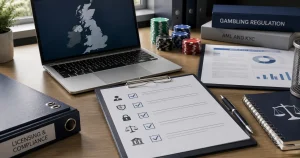


US-style branding does not establish permission to serve Britain; licensing, payout terms and missing safeguards shape the risks.
The UK rules matter more than the “USA” label
A casino can look American, use US-style branding and talk about serving players around the world. None of that tells you whether it is authorised to offer gambling to someone in Britain. The important question is not what the site calls itself, but whether the operator holds the licence required for the market it is targeting.
For online gambling offered to customers in England, Scotland and Wales, that means a licence from the UK Gambling Commission. Without one, an operator cannot legally offer its gambling services in those parts of the UK. The rule applies whether the company is based nearby or on the other side of the world. A US theme does not create an exception.
That distinction is easy to miss when a site’s front page is full of flags, dollar signs and references to American casinos. Those are branding choices, not proof of permission to serve British customers. Nor does a claim that a casino is “international” answer the licensing question. I’ve learned to treat those words as decoration until the operator’s actual status is clear. Branding is not a licence.
Where the UK boundary sits
The UK Gambling Commission’s role is about operators providing gambling to customers in Great Britain. A casino based overseas still needs the relevant UKGC licence if it is offering its services to people here. Its location does not, by itself, put it outside the rule.
This is why “USA casinos for UK players” can be a misleading description. It may mean a US-facing design or an operator that presents itself as American. It does not establish that the business is licensed in the United States, and it certainly does not establish that it is licensed by the UKGC. Those are separate questions, and a site’s own label cannot answer either one for you.
The same goes for claims about being regulated somewhere else. A foreign licence, where one exists, is not a UKGC licence. A site operating outside the UKGC system is not regulated by the Commission, and British customers do not get to treat it as though it were a UK-licensed casino just because its pages are accessible or its marketing mentions the UK.
VPN-Friendly Casinos in the UK: Access and Rules
That matters because the UK licence is the dividing line for legal provision of online gambling services in Great Britain. If the operator does not hold it, the service is not authorised for that market. This is not a technicality hidden in paperwork. It is the difference between an operator being licensed to serve customers here and not being licensed to do so.
Advertising is part of the same line
The boundary is not limited to taking bets. An unlicensed operator is also not allowed to advertise its gambling services in the UK. So an advert aimed at British customers does not become acceptable because the casino is based overseas or uses American language. The operator’s obligations depend on the market it is addressing, not just on the address on its company documents.
I would not read a banner, search result or social post as evidence of approval. Promotion can make a casino seem established and locally relevant, but it does not replace the licence check. If a site is trying to attract people in Britain without the required UKGC authorisation, that is a problem with the operator’s position, not a sign that the rules have somehow changed for that particular brand.
There is another practical distinction worth keeping straight: a casino might describe itself as US-friendly, USA-facing or open to international customers, but those phrases are not regulatory categories. They tell you how the business chooses to present its audience. They do not show that it has permission to offer gambling in England, Scotland or Wales.
Read the label carefully
When I see a US casino theme, I now separate the impression from the legal question. Is the operator licensed by the UK Gambling Commission to serve the British market? If not, the American identity does not fill that gap. A site may be offshore and outside UKGC regulation even while its pages are written in English and its marketing appears tailored to UK visitors.
Offshore operators do not offer the affordability checks mandated by the UKGC, regardless of how polished the website appears.
That also means you should not assume that an offshore casino follows the same UKGC requirements as a licensed operator. In particular, offshore operators do not offer the affordability checks mandated by the UKGC. The difference is not solved by a polished website, a familiar game lobby or an assurance that the casino is “fully regulated” somewhere else. The wording needs to be read in context: regulated by whom, and authorised for which market?
I am not saying that every site using American imagery is making the same claim, or that a flag on a homepage tells you everything about its business. I am saying that the imagery itself proves very little. The legal question is specific, and the answer rests on the operator’s UKGC authorisation—not on its name, design or chosen audience.
So when you come across an online casino presented as American but aimed at British players, keep the two ideas separate. “USA” describes the brand or the operator’s positioning. UK licensing determines whether it may legally offer online gambling services in Great Britain. One does not stand in for the other.
Recommended online casinos
- x3betBonus: Welcome Pack 100% Up to £1.000 + 200 Free Spins · Payout speed: 1-3 business days
- EvoSpinBonus: 125% up to €2500 + 125 Free Spins · Payout speed: 1-3 business days
- NightLuckBonus: Welcome Pack + 805% Up To 6400€ + 280 FS · Payout speed: 1-3 business days
- BeOnBetBonus: 100% up to €500 + 100 FS · Payout speed: 1-3 business days
- DieselwinBonus: Welcome Pack 250% up to £4000 + 200 FS · Payout speed: 1-3 business days
- JetsetspinsBonus: 200% Bonus + 100 Free Spins + Free Royal Wheel · Payout speed: 1-3 business days
- ZombillionBonus: Welcome Pack 250% up to £4000 + 200 FS · Payout speed: 1-3 business days
- AmunbetBonus: Join now and get 450% up to 2,700 GBP + 450 FS · Payout speed: 1-3 business days
- SpinFormulaBonus: 550% Up To £15,000 + 550 FS · Payout speed: 1-3 business days
- BritsinoBonus: Welcome Package – Get your £2,200 + 2,000 FS · Payout speed: 1-3 business days
What “accepting UK players” actually means
When a casino says it accepts players from Britain, that can describe what happens when you open the site and try to register. It does not, by itself, tell you whether the operator is authorised to serve customers here. I used to treat those as the same thing. They aren’t.
British casinos not on GamStop: what to know
For the UK market, a foreign casino is an online gambling operator that takes British customers without a licence from the UK Gambling Commission (UKGC). That definition is about the operator’s licensing position, not the country suggested by its name, design or games. A site presenting itself as American may still be an offshore operator from the UK’s point of view.
There is also a difference between a site being technically reachable and deliberately welcoming UK customers. Some overseas casinos are supposed to block visitors from Britain. Gambling.com has reported that some do not enforce that block, and that a basic VPN can allow users to get around it. That is a report about access, not proof that every overseas site behaves this way; policies and enforcement can change.
A VPN changes how a site sees your connection. It does not give the casino a UKGC licence, change its terms, or turn access into authorisation. Nor does a page loading cleanly prove that the operator has decided to serve you: the block might be poorly enforced, or the site may not have stopped you at that point in the process.
That distinction matters if you come across a list claiming to identify USA casino sites that accept UK players. “Accepts” might mean a UK visitor can view the homepage, create an account, or reach the games. Those are not necessarily equivalent, and none establishes that the operator has permission to provide gambling services to British customers. The word can make an access test sound like a regulatory endorsement. It isn’t.
A VPN may allow access to overseas sites that are supposed to block UK visitors, but it does not provide the operator with a UKGC licence or change the terms of service.
I would read claims about US-facing slot sites in the same cautious way. A US-style theme or branding tells you little about whether the operator holds a licence for the British market. What matters here is whether it holds the relevant UKGC licence. Offshore casinos are not regulated by the UKGC, and they do not provide the UKGC-mandated affordability checks that apply within its system. That is a meaningful difference, not a footnote to the branding.
There is no reliable shortcut in the phrase “UK players welcome”. A site may display that wording, let you browse, or accept details during registration, while still being outside the UK regulatory framework. Equally, if access appears possible only after changing your connection, that is a technical workaround, not evidence that the operator is authorised here. I would not use either experience as a substitute for checking the operator’s position.
The practical temptation is obvious: if the page opens and the sign-up form works, it feels as though the site has made a clear decision. But the screen tells you only what the site allows at that moment. It cannot settle the separate question of whether the operator is licensed to serve the UK market.
So when you see “accepting UK players”, read it as a claim about access unless it clearly establishes something more. A reachable site and an authorised operator are different things. Easy to confuse.
Real-money play comes with real payout risk
The uncomfortable part of real-money play is not placing a bet; it is finding out what happens when you ask for your winnings back. A casino page can make depositing feel simple, but that tells you very little about how a dispute will be handled. With an offshore operator, the UK Gambling Commission is not the regulator overseeing the business. That difference matters most when the operator says no.
Non-GamStop European Casinos: UK Rules Explained
There have been reported cases in which unlicensed gambling sites refused to pay customers’ winnings, leaving those customers without legal recourse. Gambling.com has reported on this risk; it should not be read as proof that every offshore casino behaves that way. But it is enough to make me wary of treating a displayed balance as money safely in my hands. Until a withdrawal reaches you, the operator still controls whether it releases the funds.
That is easy to forget when an account shows a win. I have looked at a balance and mentally spent it before it was actually mine. The screen makes the money feel settled. It isn’t.
If a UK-licensed casino has a dispute with a customer, it sits within the UK regulatory system. An offshore casino serving British customers without a UK Gambling Commission licence does not. So a UK player cannot assume the same regulator is available to deal with a complaint or press the operator to resolve it. A polished site, American-themed branding or a familiar-looking cashier does not change that position.
This is why the phrase “USA online casino” can be misleading when you are assessing where your money might end up. It describes how a site presents itself, not the protections that apply to your account. Some operators are licensed offshore, but that does not make them regulated by the UK Gambling Commission. If something goes wrong, the UKGC cannot be treated as though it supervises that operator.
Payout Risk
Unlicensed gambling sites may refuse to pay winnings, leaving customers without legal recourse since the UK Gambling Commission does not oversee these businesses.
Nor should the fact that a site accepted your deposit be taken as evidence that it will honour a later withdrawal. Acceptance is a technical event; paying out is a decision the operator must actually make. Those are not the same thing. A casino may display rules and conditions, but if you are dealing with a company outside the UK system, enforcing your understanding of those terms can be difficult.
I now try to separate two thoughts that used to blur together: “I can play here” and “I can get my money out if there is a disagreement.” The first can look obvious when registration and deposits are available. The second is where the risk becomes real. That distinction is more useful than a welcome message or a reassuring badge.
Before you put money into an account, consider whether you could accept the possibility of a dispute ending with the balance withheld. Read the operator’s terms, keep copies of relevant account records, and avoid depositing money you cannot afford to lose. Those steps do not create UKGC oversight or guarantee a successful claim. They simply help you make the decision with your eyes open.
There is another protection difference worth keeping in view: offshore operators are not subject to UKGC-mandated affordability checks. That does not make a refusal to pay more likely by itself, but it means you should not assume the safeguards required of a UK-licensed casino are present. A site may look familiar while operating under a different regulatory framework.
When you are weighing American casinos that appear to accept customers from Britain, focus less on the size of the promise and more on who stands behind the operator. If the answer is not the UK Gambling Commission, understand that a payout dispute may leave you with fewer practical options. The risk is not abstract. It concerns money you have already deposited and may be counting on receiving.
Welcome bonuses: read the wagering maths first
A large welcome package looks generous in an advert. I’ve learned to ignore the headline until I know what the bonus asks me to do. With USA online casino sites aimed at UK players, the offer can be more prominent than the terms that decide whether its value is usable.
A specialist review reports that foreign casinos may advertise larger welcome packages because they are not bound by UK Gambling Commission restrictions on bonus terms, wagering requirements and promotional language. That is a description of the offers covered by that review, not a promise that every site has a bigger or better deal. These operators are not regulated by the UKGC, and they do not provide UKGC-mandated affordability checks. Big headline, different safeguards.
The formats mentioned in specialist coverage include deposit matches, free spins, cashback and no-deposit offers. A deposit match adds bonus funds in relation to what you deposit; free spins are tied to specified games, while cashback is calculated under the operator’s terms. Those labels tell you the shape of an offer, not what you must do before bonus funds become withdrawable. Read the rules attached to the specific promotion.
Bonus Calculation
Step 1: Identify the bonus and requirement
Take a 100% match bonus of £100 with a 35x wagering requirement.
Step 2: Multiply the bonus by the requirement
£100 × 35 = £3,500.
Step 3: Determine the betting obligation
Place £3,500 in qualifying bets before the bonus funds can be converted into withdrawable cash.
The key figure is the wagering requirement: how much qualifying betting must take place before bonus funds can be converted into withdrawable cash. A specialist review illustrates the arithmetic with a 100% match bonus of £100 and a 35x requirement. On that basis, the player would need to place £3,500 in qualifying bets before the bonus funds convert. The offer may be described as “free”; the betting obligation is not.
That calculation only helps if you know what the multiplier applies to. Read the wording to establish whether it is based on the bonus alone or another amount, and which bets count. A requirement tied to a different base changes the total. So can restrictions on eligible games or the order in which bonus and deposited funds are used. Don’t assume the advert explains any of this.
When comparing USA casino welcome bonuses for UK players, I’d put the full terms beside the headline and work through the arithmetic before depositing. If the operator does not make the wagering basis clear, treat the advertised value as uncertain rather than counting it as money you can use. The same goes for a large match: a higher bonus can mean a larger qualifying-bet total, not a better deal.
I’ve fallen for the big number before. Now I check what sits behind it: the wagering basis, qualifying bets and conversion rule. Only then does the offer make sense. Mark the maths first.
A new site is not automatically a safer site
A new US-facing casino can look polished and still leave basic questions unanswered. I’ve learned not to treat a fresh design, a familiar-looking payment page or the word “secure” as evidence that an operator is safe to use. They are claims to check, not proof.
Start with the licence. Find the operator’s legal name and the regulator it says oversees it, then check whether the licence can be verified with that regulator. A licence from abroad does not authorise the site to serve customers in Britain: remote gambling operators serving the British market need a UK Gambling Commission licence. Non-GamStop casinos operate outside the Commission’s system, so they are not regulated by the UKGC. They also do not provide UKGC-mandated affordability checks.
Some specialist reviews describe non-GamStop sites as having encryption to protect personal and financial information, and report that many hold licences from other authorities. That is not a guarantee about a particular new casino. Look for a clear explanation of who operates the site, what licence it holds and how it handles your information. If the claims cannot be checked, the tidy homepage does not fill the gap.
Then read the terms before creating an account or depositing. I used to skim past the withdrawal section because the sign-up offer had already caught my eye. That was backwards. Check whether the operator explains identity checks, withdrawal limits, pending periods, and any conditions attached to taking money out. These details can differ considerably between operators, according to specialist reviews, so do not assume a new site follows the policy of another casino with similar branding.
Verifying New Casinos
- Verify the operator’s legal name and license with the stated regulator.
- Check for a valid UK Gambling Commission licence for British market access.
- Review the withdrawal section for identity checks and limits.
- Save a copy of the terms and conditions.
A useful check is whether the rules are easy to find and specific enough to understand. If you cannot tell what documents may be requested, how a withdrawal is handled, or what could delay it, pause rather than relying on a promise in a banner or chat window. Save a copy of the terms you read; they may change, and a clear record helps you remember what you agreed to.
There is no reliable shortlist of new US casino sites that makes this homework unnecessary. A launch date says nothing about the quality of a licence, the strength of security or the fairness of cash-out conditions. The operator has to stand behind those details. If it does not explain them plainly, I would not let novelty make the decision for me.
New does not mean safer. Check first.
Getting real money out: expect operator-specific rules
A casino saying it pays real money tells you very little about what happens when you request a withdrawal. “Real money” describes the kind of balance on offer; it is not a promise that cashing out will be simple, or that every player will face the same process. I used to treat the headline claim as the useful part. It isn’t.
A specialist review has reported that withdrawal limits, pending periods and verification procedures can differ considerably between operators. That matters more than a broad claim about paying UK players. One site may set its own cap on withdrawals, another may hold a request before processing it, and another may ask for documents as part of its checks. Those are operator rules, not a shared standard you can assume from the casino’s “USA” branding.
If an advert says same-day withdrawals, read it as a claim to investigate, not a timetable you can rely on. A stated processing period might not describe the full journey from request to money received, and a headline can leave out conditions that apply to your account. I would look for the withdrawal terms before depositing: how limits are set, whether requests can remain pending, and what verification the operator requires. If those points are hard to find or unclear, that is useful information in itself.
There is an important difference between a UKGC-licensed casino and an offshore one here. Offshore casinos are not regulated by the UK Gambling Commission, and they do not have to follow UKGC requirements, including mandated affordability checks. The Commission requires UKGC-licensed operators to verify a player’s identity before processing withdrawals; that requirement should not be mistaken for a guarantee that an offshore operator will use the same process or offer the same safeguards.
So when you compare USA-branded casinos that claim to pay British customers, focus on the written conditions attached to your account, not the label. Check whether the operator explains its withdrawal rules clearly and whether its claims match those terms. Don’t assume that “same day” means the same thing from one site to another, or that a promise settles what will happen to your own request.
Do
- Check specific withdrawal rules before depositing
- Investigate stated processing periods
- Verify available withdrawal methods
Don’t
- Rely on “same-day” advertising as a guarantee
- Assume “USA” branding implies shared standards
- Mistake a deposit’s acceptance for payout security
I’m not trying to make every process sound like a problem. I’m saying a payment claim alone cannot tell you how much you can withdraw, how long a request may be held, or what checks may apply. Those details belong to each operator. Read them before you deposit. No guesswork.
GamStop and the safeguards you may leave behind
GamStop is designed to make a self-exclusion apply across UK-licensed gambling sites, rather than just the one where you signed up. Once you register, you are locked out of every operator licensed by the UK Gambling Commission. That shared block is the point: moving from one UK site to another does not undo the exclusion.
A casino based in the US, or one using US branding, is a separate matter. If it operates outside the UKGC’s remit, it does not take part in GamStop. That means the exclusion you set up through the scheme does not automatically stop you registering with that operator. The distinction is easy to miss when you are focused on finding somewhere to play. It matters more than the branding.
A specialist review reports that someone who has self-excluded through GamStop may be able to register with a foreign casino and deposit without those safeguards. That is a reported possibility, not a promise about every site or a recommendation to try it. The practical point is that GamStop’s block does not travel with you beyond the UK-licensed system.
I would treat that gap as a reason to pause, not as a clever workaround. Self-exclusion is often chosen at a moment when a person has decided they need distance from gambling. Looking for another account soon afterwards can undo that distance while leaving the original exclusion in place. It can also mean that controls attached to UKGC-licensed operators are no longer there to support you. Offshore casinos are not regulated by the UKGC, and they do not offer UKGC-mandated affordability checks.
That does not mean every foreign site behaves alike, or that a particular safeguard will be absent in every possible form. It does mean you cannot assume that a UK scheme or UKGC requirement applies there. The casino’s own statements are not a substitute for GamStop coverage.
If you have self-excluded and feel pulled towards another account, give yourself time before sharing details or making a deposit. Contact someone you trust, or a gambling support service, and explain what is happening. I know the temptation to think, “Just one account.” That can be the moment the protection you chose stops helping.
The useful question is not whether a site will let you through. It is whether you are trying to get around a boundary you put in place for a reason. A US-facing casino may accept a UK visitor, but that does not make it part of GamStop or restore the safeguards of the UK-licensed system. Keep that distinction clear.
GamStop exclusions do not automatically apply to foreign casinos operating outside the UKGC’s remit.
No-deposit offers still come with strings attached
A “no-deposit” bonus sounds like money you can claim without putting your own funds in. That label tells you how the offer starts; it does not tell you whether any resulting winnings can be withdrawn straight away. I’ve learned to treat the headline as the beginning of the terms, not the useful part.
A specialist review of foreign casinos serving UK players identifies four familiar promotion types: deposit matches, free-spin packages, no-deposit bonuses and cashback offers. They work differently, but none of those labels explains the full deal. Before registering with a new US-facing casino or considering a no-deposit offer, look for the actual rules attached to that specific promotion.
For a no-deposit bonus, check what qualifies as a win, whether winnings are capped, which games count towards any playthrough condition, and whether you need to make a deposit before requesting a withdrawal. Those details can decide whether a balance is usable cash or only a figure on screen. If the terms are hard to find, unclear, or change between the promotion page and the account rules, I’d pause rather than assume the most generous reading applies.
The same goes for free spins and cashback. Free spins may be restricted to particular games, while cashback can depend on how the operator calculates eligible losses. A deposit match may look separate from a no-deposit offer, but the important question remains the same: what must happen before funds become withdrawable? Read the promotion’s conditions, not just its name.
Wagering requirements are a good example of why the maths matters. A specialist review gives this illustration: a £20 bonus with a 35x requirement calls for £700 in qualifying bets before cash-out. That is the amount wagered, not a promise that you will have £700 left—or that you will win. The distinction is easy to miss when an offer is presented as “free”.
There is another catch beyond the promotion itself. Non-GamStop casinos are outside the UK Gambling Commission’s system, and offshore operators do not provide the UKGC-mandated affordability checks. A bonus does not replace those protections. Nor does a US theme establish that the site is licensed to serve customers in Britain.
I’d compare the terms with the amount you are genuinely prepared to lose, and skip the offer if the conditions are not clear. “Free” can still cost you time, money, or both.
Fast withdrawals: e-wallets, bank transfers and crypto
“Instant” sounds reassuring until you find out what the clock is measuring. A casino may approve a withdrawal quickly, but the payment method still has to deliver the funds. I’d separate those steps rather than treating a fast-sounding option as a promise of money in your account straight away.
For Skrill and Neteller, reports on foreign casinos say most transactions are cleared within 24 hours, with many processed in under 12 hours. That makes e-wallets a relatively quick route on the figures reported. It does not mean every operator uses the same timetable, or that every withdrawal will land within those windows. Check whether a published estimate refers to the casino’s approval or the full transfer.
E-wallets (Skrill/Neteller)
Often cleared within 24 hours, with many processed in under 12 hours.
Bank Transfers
Slower route, typically taking five to seven business days.
Crypto
Often the quickest, clearing in under an hour, though subject to value changes.
Bank transfers are reported as the slower choice. A specialist review puts the banking timeline at five to seven business days, and notes that some casinos add their own processing delay before a transfer is sent. So a casino’s internal queue can matter as much as the bank itself. “Fast payout” is not a useful description unless the terms explain when processing begins and what happens after approval.
Crypto can be quicker on paper: a specialist review reports that withdrawals at foreign casinos often clear in under an hour, faster than fiat methods. But speed is only one part of the decision. Crypto’s value can move, so what arrives may not retain the same value as when you requested the withdrawal. Quick is not the same as predictable.
There is another distinction worth keeping in view. A payment estimate tells you about timing, not whether a particular operator is reliable or whether a withdrawal will be approved. Offshore casinos are not regulated by the UK Gambling Commission, and they are not subject to UKGC-mandated affordability checks. A short processing estimate does not replace those protections or make the operator part of the UK system.
Before depositing, look for the withdrawal section of the terms and check which methods are actually available for withdrawals, not just deposits. Note any stated processing period and whether it starts when you submit a request or after the casino reviews it. If the page only says “instant” without explaining what that means, I would treat the wording as advertising, not a timetable.
For a UK player comparing Skrill, Neteller, bank transfer and crypto, the reported pattern favours e-wallets for speed, puts bank transfers at the slow end, and makes crypto the quickest but more exposed to value changes. None of those labels tells you the full story on its own. Read the operator’s conditions before you move money.
Non-UK-Regulated Casinos: What UK Players Should Know
Can you legally play at an overseas casino from the UK?
For you as a player, placing a bet with a casino licensed outside the UK is not, by itself, a criminal offence. UK law does not prohibit an individual from betting with an overseas operator, and there is no criminal penalty simply for doing so.
That is only one side of the distinction. An operator’s position is different: a remote gambling business offering services to customers in Great Britain must hold a UK Gambling Commission licence. An American theme, a US address or a licence issued overseas does not replace that requirement. So when people ask whether UK players can use USA online casinos, the answer about the player’s legal liability should not be mistaken for approval of the operator’s business.
I used to read “available to UK players” as if it meant “allowed to serve the UK”. It doesn’t. It may describe what a website lets you do, not whether the operator has permission to provide gambling services here. That distinction is easy to miss when a sign-up page loads without a fuss.
Non-GamStop casinos operating offshore are not regulated by the UKGC. They also do not provide the UKGC-mandated affordability checks that apply within its regulatory system. That does not make your act of placing a bet a crime, but it does mean you should not treat an overseas licence as equivalent to UK oversight or assume the same protections apply.
The practical question and the legal one are separate. A site may be reachable from Britain; that alone says nothing about whether its operator is authorised to serve British customers. Equally, the fact that the operator may lack that permission does not make the player criminally liable under UK law.
So, if you are asking whether you personally can be prosecuted merely for betting at a casino licensed abroad, the answer is no. If you are asking whether that casino is entitled to offer its service to UK customers, that depends on the operator having the required UKGC licence. Two different responsibilities. Don’t blur them.
Are bonuses at foreign casinos actually better than at UKGC-licensed sites?
Often, yes: foreign casinos commonly offer larger welcome packages, including deposit matches, free spins, no-deposit bonuses and cashback. Check the wagering terms carefully—for example, a 35x requirement on a £20 bonus means £700 in qualifying bets before you can cash out.
Are foreign casinos safe for UK players to use?
There is no guarantee: some offshore casinos use encryption and hold licences elsewhere, but they are not regulated by the UK Gambling Commission. Unlicensed sites have sometimes refused to pay winnings, leaving customers with no legal recourse.
How do I know if an online casino is safe?
Check whether the operator holds a UK Gambling Commission licence to serve customers in Great Britain. A foreign licence, American branding or a claim that a site is regulated elsewhere does not provide UKGC authorisation.
What happens if I have a dispute with a foreign casino?
You may have limited options: some unlicensed sites have refused to pay winnings, leaving customers with no legal recourse. A foreign licence does not make the casino subject to UKGC regulation.
Are gambling winnings subject to income tax in the United Kingdom?
No. Gambling winnings are not subject to UK income tax, whether the casino is UKGC-licensed or not.
Can I play at a casino licensed outside the UK?
Yes. UK law does not prohibit an individual from betting with an overseas operator, and there is no criminal penalty for the player. However, an operator without a UKGC licence cannot legally offer gambling services to customers in England, Scotland and Wales.
What does wagering requirement actually mean in practice?
It is the amount you must stake in qualifying bets before bonus funds can be withdrawn. For example, a 35x requirement on a £20 bonus means placing £700 in qualifying bets.
Is it legal for UK residents to use casino sites that operate outside the UK’s licensing framework?
There is no law prohibiting a UK resident from placing bets with an overseas operator, and the player faces no criminal penalty. But an operator without a UKGC licence cannot legally provide gambling services to customers in England, Scotland and Wales or advertise those services in the UK.
Material created by the team Basswin UK Guide