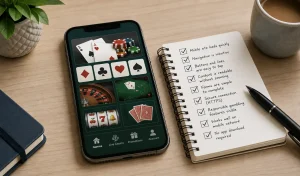


Crypto listings can be broad; availability depends on the specific coin, cashier, account and UK location.
USDC Support Is Not the Same as a Crypto Mention
A casino page can mention cryptocurrencies without confirming that you can deposit USDC there. That distinction sounds obvious, but I have been caught by broad payment wording before: I saw “crypto accepted”, assumed the coin I wanted would be available, and only found out the cashier had its own narrower list. The phrase is a starting point, not proof.
A specialist review of casino payment options describes websites listing several cryptocurrencies alongside methods such as Visa, Mastercard, bank transfer and e-wallets. That tells you those payment categories appear in the material it examined. It does not show that every named casino accepts every coin, that USDC is among them, or that an option is available to a customer in the UK now. A list can be useful for deciding what to check. It cannot replace checking the operator’s own cashier.
Read the payment claim literally
“Crypto” is a broad label. It does not tell you which coins are supported, whether the cashier accepts deposits in USDC specifically, or whether the option is enabled for your account and location. Even a casino page that names cryptocurrencies may be describing a general service rather than the choices currently presented at the point of payment.
That is why I would not treat Bitcoin support, or a logo row containing several coins, as evidence of USDC support. Nor does a general mention of stablecoins settle the question. Look for USDC by name in the cashier after signing in, and read the payment instructions attached to that option. If the cashier instead directs you to a processor, check what that processor actually lets you select before you commit.
The wording matters. A page saying “crypto deposits” may be accurate while still leaving the specific coin unconfirmed. “USDC accepted” is more precise, but I would still check that the option appears in the live cashier. Payment information can change, and a page describing a method is not the same thing as an available button on your account.
Casinos That Accept UKash in the UK: What to Check
Check the live cashier, not just the headline
The cashier is where a general claim becomes a practical answer. Check whether USDC appears as a deposit choice, whether the cashier gives instructions for sending it, and whether those instructions match the payment route you intend to use. If the label is missing or unclear, ask customer support to confirm the exact coin and route before transferring anything. A vague reply that repeats “we accept crypto” does not answer the question.
Do not assume that an option shown in a review, advert or old account screenshot will still be available. A specialist review may provide a snapshot of the websites it covered, but payment menus can change and may differ by location or account. The same caution applies when a site is described as new or promoted as a place for USDC users: the description is not a substitute for seeing the method in your own cashier.
The checking process is dull. Better dull than guessing.
Treat availability and eligibility as separate checks
Even when a payment method is listed, the cashier may still be the place to confirm whether it is currently available to you. A specialist review listing Visa and Mastercard, for instance, is not proof that either card product can be used in every UK account. Current availability and card eligibility need checking in the cashier. The same basic principle applies to a crypto claim: a general list does not establish your access to a particular payment option.
For USDC, keep the question narrow: is this exact coin available as a deposit method for this account, through the route displayed by the operator? Do not infer the answer from a casino’s general crypto branding, from another customer’s experience, or from a page that does not identify USDC. If the operator cannot give a clear answer, pause rather than trying a different coin or route on the assumption it will work.
This is not me saying that no UK casino accepts USDC. It is me refusing to turn a broad crypto claim into a specific promise. For remote gambling operators selling into the British market, the relevant operating licence is issued by the UK Gambling Commission, regardless of where the operator is based. That licensing question is separate from payment support: a licence does not prove USDC is available, and a crypto logo does not establish the operator’s licensing position. Check both things directly rather than letting one stand in for the other.
Do
- Check for USDC by name in the live cashier after signing in
- Read the specific payment instructions attached to the option
- Confirm the exact coin and route with customer support
Don’t
- Treat a general “crypto accepted” mention as proof of USDC support
- Assume Bitcoin support or logo rows evidence USDC availability
- Rely on a general mention of stablecoins to settle the question
So, if you are looking for a UK casino where USDC can fund an account, make the cashier your final check. The useful evidence is a clear USDC option and instructions that apply to you—not merely a mention of cryptocurrencies somewhere on the site. No guesswork.
If USDC Is Unavailable, Check the Other Payment Routes
If USDC is not offered at a casino’s cashier, you may still have a practical way to fund an account. The alternatives are familiar UK payment routes: debit cards, bank transfers and open banking, e-wallets, and prepaid vouchers. The important bit is not how many logos appear on a payment page. It is whether the method you intend to use is available to you at that particular site.
Debit cards
Debit cards are a common starting point. UK casinos commonly accept Visa and Mastercard debit cards, although that does not mean every card will work at every cashier. Check the payment options after signing in, and make sure the card is yours and that its details match your casino account. A mismatch in basic ownership information can turn a straightforward transaction into an unnecessary back-and-forth.
I would not treat a familiar card logo on a general payments page as confirmation that it will appear for your account. The cashier is the useful check. It shows the options the operator is presenting for your account at that point, rather than what may be available elsewhere or in a general description.
Casinos That Accept Boku in the UK: Current Options
Bank transfers and open banking
Bank transfers and open banking services are another route to look for. A specialist review describes these methods as capable of making deposits instantly and supporting fast withdrawals at many sites; that is a report about availability across sites, not a promise about the casino you are considering. The options shown in its cashier, and the details provided there, are what matter for your transaction.
Open banking is not the same thing as choosing a cryptocurrency at checkout. You are authorising a payment through a banking route rather than sending USDC from a crypto wallet. If you want to keep the process clear, check the payment screen before you proceed and confirm the amount and account details it displays.
E-wallets
Skrill and Neteller appear at some casino sites, but their presence is not universal. A specialist review also notes that these wallets may be left out of promotions. That is worth knowing even when you are not choosing a payment method for a bonus: a payment button does not by itself tell you whether the deposit is eligible for an offer.
PayPal is another name you may come across. It is often valued for speed and convenience, but a specialist review reports that it can be excluded from bonus eligibility. That is a reason to read the offer’s payment conditions rather than assuming every cashier option counts in the same way. I have learned not to let a polished “instant” label do the checking for me.
Availability can also depend on the operator and the account. If a wallet is not shown in the cashier, do not assume that registering for it will make it available. If it is shown, check that the account you use belongs to you and that the displayed payment amount is the one you intend to send.
Debit Cards
Commonly Visa and Mastercard; check the cashier to ensure the card is yours and details match your account.
Bank Transfers & Open Banking
Routes for instant deposits and fast withdrawals; verify the payment screen and account details before proceeding.
E-wallets
Includes Skrill, Neteller, and PayPal; check bonus eligibility as some wallets may be excluded from offers.
Prepaid vouchers
Paysafecard works differently from a card, bank route, or wallet: it is a prepaid voucher for deposits, not a general route for moving money both ways. That makes it worth considering only if you want to fund an account and understand the limitation. Check the casino’s own instructions before buying or entering a voucher, so you know how the code is applied and whether the method suits your plans.
A prepaid option can feel more separate from your everyday banking, but it is still a real-money deposit. Keep the voucher details secure and use the cashier’s instructions rather than guessing how the code should be entered.
Check the cashier, not the branding
Some UKGC-licensed casinos also accept Apple Pay for deposits. Other payment names you may encounter include Trustly and Jeton, but seeing a brand mentioned in a general guide does not establish that a particular casino currently offers it to you. The operator’s cashier is the practical point of reference.
Before choosing, take a moment to compare what is actually available: the payment route, the account details it asks for, and any conditions attached to using it. Online gambling is legal in the UK for adults aged 18 and over when the operator holds the relevant UK Gambling Commission licence. Check the operator’s current licence on the public register before depositing. That is a separate check from deciding which payment method suits you.
There is no need to force a crypto route if the cashier offers a more familiar alternative. Nor should a site’s general mention of cryptocurrencies be taken as a reason to deposit by another method without checking the terms. Pick from the methods actually displayed, and make sure you understand what each one is for. No guesswork.
Casinos That Accept Dogecoin in the UK: What to Check
Recommended online casinos
- x3betBonus: Welcome Pack 100% Up to £1.000 + 200 Free Spins · Payout speed: 1-3 business days
- EvoSpinBonus: 125% up to €2500 + 125 Free Spins · Payout speed: 1-3 business days
- NightLuckBonus: Welcome Pack + 805% Up To 6400€ + 280 FS · Payout speed: 1-3 business days
- BeOnBetBonus: 100% up to €500 + 100 FS · Payout speed: 1-3 business days
- DieselwinBonus: Welcome Pack 250% up to £4000 + 200 FS · Payout speed: 1-3 business days
- JetsetspinsBonus: 200% Bonus + 100 Free Spins + Free Royal Wheel · Payout speed: 1-3 business days
- ZombillionBonus: Welcome Pack 250% up to £4000 + 200 FS · Payout speed: 1-3 business days
- AmunbetBonus: Join now and get 450% up to 2,700 GBP + 450 FS · Payout speed: 1-3 business days
- SpinFormulaBonus: 550% Up To £15,000 + 550 FS · Payout speed: 1-3 business days
- BritsinoBonus: Welcome Package – Get your £2,200 + 2,000 FS · Payout speed: 1-3 business days
A Deposit Method Is Only Half the Story
I used to judge a payment option by the deposit screen: if the button appeared and the money went in, I counted it as sorted. That was too early. The useful question is whether the same route can also handle a withdrawal, and what the casino requires if it cannot.
For a UK casino, anti-money laundering rules generally mean a payout must go back to the original payment source. That can make the route you use to fund an account relevant long after the deposit has cleared. A cashier showing USDC as a way to pay does not, by itself, tell you how winnings are returned. The withdrawal terms and cashier need to answer that separately.
Before depositing, I’d check whether the casino allows withdrawals in USDC, whether they must go to the wallet used for the deposit, and whether another payment method is used instead. Those are not details to guess from a general “crypto accepted” claim. If the site’s wording is unclear, ask support to explain the payout route in writing before you send funds.
Check the ownership trail
The account and payment method should belong to the same person. Using your own account details and a payment route in your name reduces the chance that basic ownership checks create avoidable friction. If a deposit comes from a wallet or account that does not clearly belong to you, sorting out who owns the funds may become part of the withdrawal process.
Attention: Anti-money laundering rules generally require payouts to return to the original payment source, making the deposit route relevant for future withdrawals.
That matters with any payment route, including a USDC wallet. Check that you can identify the wallet as yours and that the casino’s instructions match the route you intend to use. Do not assume that a payment can be sent from one place and later withdrawn to another just because both methods appear on the site. Closed-loop rules may limit that flexibility.
KYC can also affect timing. A specialist casino review notes that processing can take longer on a first withdrawal while verification is completed. That is a description of a possible delay, not a timetable you can rely on. Have the requested account details ready, and read the operator’s own withdrawal terms rather than treating a deposit confirmation as proof that your account is fully cleared.
A casino may also need to review a withdrawal internally before it is sent. So “instant deposit” tells you nothing definite about how quickly you will receive a payout. I learned not to confuse money arriving in the account with money being available to take out. Different stages. Different checks.
Trace the route before you commit
If a site says it accepts USDC, look for clear instructions covering both directions: how the deposit is credited and how an approved withdrawal is paid. Confirm that the wallet address or account details you will use are accepted for the relevant transaction, and check whether the operator specifies a particular route. A vague promise that crypto is supported does not settle those practical points.
This is especially worth doing if the casino says withdrawals must return to the original source. Ask what happens if the original route cannot receive a payout, or if the casino requires an alternative after reviewing your account. The answer may affect whether the payment method is workable for you at all.
UPaycard Casinos in the UK: Check the Cashier First
I would also keep a record of the cashier wording and any support reply. Not because it guarantees a smooth payout, but because it gives you something specific to refer back to if the instructions seem to change. The aim is not to find a method with an attractive deposit button. It is to know where an approved withdrawal can go, what ownership checks apply, and whether the route fits your account before you fund it.
A payment method is only useful if the way back is clear. Don’t skip that check.
Playing Slots on Mobile Does Not Confirm a USDC Option
A slot opening smoothly on your phone tells you about the game, not the cashier. I’ve learned to keep those checks separate: a mobile-friendly site may let you play through a browser, but that alone says nothing about whether USDC appears as a deposit method for UK customers.
The same goes for a page describing “crypto” payments. That label does not confirm that USDC is supported, and a payment option mentioned outside the cashier may not be available for your account. If you want to know whether you can fund an account with USDC, check the payment methods shown after signing in, before making a deposit. Don’t infer it from a slot’s mobile compatibility.
There’s a separate check behind the word “legit”: whether the operator is authorised for the market. In Great Britain, remote gambling licensees serving customers must hold the relevant UK Gambling Commission licence, wherever the company is based. You can check the licence number against the Commission’s public register. A polished mobile site is not a substitute. Looks can mislead.
In Great Britain, remote gambling licensees must verify a customer’s age before allowing a deposit into a gambling account.
The rules for online slots also apply when you play on a phone. In Britain, autoplay is not allowed, and a slot spin must take at least two and a half seconds. The maximum stake per game cycle depends on age: it is £5 for customers aged twenty-five and over, and £2 for those aged eighteen to twenty-four. The higher limit took effect on 9 April 2025; it does not apply to younger adults.
Mobile access does not change the age requirement either. A remote gambling licensee must verify a customer’s age before letting them deposit into a gambling account. So if a site makes registration and play look effortless, that is not proof that it has skipped the checks it is supposed to make.
I’d treat claims about mobile slots and payment support as two separate statements to verify. First, is the operator licensed for Great Britain? Then, does its cashier actually offer USDC to you? If you also want to play on a phone, check that the game works there—but don’t let that answer the payment question by implication. Small distinction. Important one.
Real-Money Slot Play and the Payment Route
A slot can be available for real-money play without accepting USDC. Those are separate checks: one tells you whether you can stake money on the game; the other tells you whether the casino will let you fund your account with that particular asset. I used to treat “crypto casino” as if it answered both. It doesn’t.
If you want to play slots with USDC, start with the casino’s cashier while signed in, not a game page or a general payments banner. Look for USDC as a named deposit option and check that it is available to you in the UK. A site may mention cryptocurrency without identifying which coins it accepts, and a list of games says nothing about how the account can be funded. “Crypto-friendly” is a label, not a payment confirmation.
The same goes for real-money slot pages. They show what kind of play a casino offers; they do not establish that USDC is accepted, that it can be used for your account, or that a deposit will be credited in the way you expect. Before sending funds, check the displayed currency, the instructions for the selected payment route and any conditions shown in the cashier. If USDC is not explicitly available there, don’t assume a wallet transfer will work.
Casinos That Accept eCheck in the UK: What to Check
There is another distinction worth keeping straight: a free-play mode is not the same as real-money play. A game you can try without staking cash does not prove that you can later fund real-money spins with USDC. Nor does the phrase “no deposit” by itself tell you that a casino offers a USDC-funded route. Read what the offer or game mode actually says, then verify payment separately.
For real-money gambling in Great Britain, the operator must hold a UK Gambling Commission licence. I’d check the licence on the Commission’s public register before creating an account or depositing; a polished slot lobby is not evidence of regulatory status. The operator must also verify your age before allowing a deposit.
My own rule now is simple: I don’t connect the game choice to the payment choice until both are confirmed independently. First, establish that the casino is licensed and that the slot is offered for real-money play. Then confirm USDC in the logged-in cashier and follow the casino’s stated deposit process. If the cashier only lists other currencies or payment routes, that is not a hidden USDC option. It’s a reason to pause.
It sounds obvious. I still check.
Card Deposits, Crypto Claims and the Credit-Card Ban
A casino listing Visa or Mastercard does not mean every card bearing those logos will work. Debit cards are commonly used at UK casinos, but the card’s product type and the cashier’s current options still matter. A specialist review may list Visa and Mastercard, yet that is not confirmation that a particular card is eligible for a deposit today. I’d check the cashier rather than assume the logo settles it.
The distinction between debit and credit is important. The UK regulator banned credit-card gambling on 14 April 2020, and the rule has not been relaxed. UK-licensed casinos cannot accept credit-card payments for gambling. That restriction also covers credit-card funding routed through a money service business, so using an intermediary does not make a credit card an acceptable workaround.
Casinos That Accept Solana in the UK: What to Check
Wallets need the same kind of care. A payment presented as a wallet transaction is not automatically permitted if the wallet lets credit-card funds be used for gambling. Remote gambling operators cannot accept that kind of wallet payment. Check how the wallet is funded and what the casino allows, not just the payment button’s name. Small distinction, real consequence.
Apple Pay is another route you may see: some UK Gambling Commission-licensed casinos accept it for deposits. Its presence does not establish that every linked card can be used, or that the casino accepts USDC. Keep the questions separate: is the card an eligible debit card, and does the cashier explicitly offer USDC? A card logo cannot answer the second one.
That is also how I’d read claims about USDC debit-card casinos or USDC deposits for slots. A casino might list cards and separately mention cryptocurrencies; neither mention proves that USDC itself is supported. Look for USDC as a named option in the cashier, and confirm that the payment route shown is one you can use without relying on prohibited credit-card funding. If it is absent, don’t treat a general “crypto accepted” claim as confirmation.
I’ve made the mistake of treating a familiar payment logo as a green light. It isn’t. Card eligibility and USDC availability are separate checks, and a casino’s payment page can change. If you cannot identify the card as an eligible debit product, or cannot see USDC expressly offered, pause before depositing. No clever detour.
Bonus Terms Can Change Which Payment Method Makes Sense
A welcome bonus and a payment method answer different questions. The offer tells you what a casino may award under stated conditions; it does not confirm that USDC is accepted, or that a USDC deposit qualifies. I’d check those points separately before opting in. The headline can look generous while the small print changes the deal.
Start with the promotion’s eligible payment methods and exclusions. Some offers apply only to deposits made by specified routes; others exclude particular e-wallets or require you to enter a bonus code before depositing. If USDC appears in the cashier but not in the offer terms, don’t assume the deposit will trigger a welcome bonus. Ask support for written clarification if the wording leaves room for doubt.
Credit Card Ban
UK-licensed casinos cannot accept credit-card payments for gambling, including funding routed through a money service business.
A specialist review has reported that PayPal may be excluded from bonus eligibility, while Skrill and Neteller can also be excluded from promotions. Those are not fixed rules for every casino or offer: terms can change, so the casino’s own current promotion rules are the place to check. A payment route being available does not mean it is eligible for a bonus.
The same distinction matters when you see an offer described as a slots bonus or a no-deposit bonus. The label says little on its own about which games, payment methods or account conditions apply. Read the terms for the specific promotion, including any bonus-code instructions, rather than relying on a banner or a general welcome-offer page.
I’d also make sure you understand what happens if you claim the offer and then change your mind. The terms may explain how a bonus is removed or what conditions apply before withdrawing winnings linked to it. Don’t deposit first and hope the cashier sorts it out later. That’s how a small uncertainty becomes a frustrating one.
For a USDC deposit, treat bonus eligibility as an independent check: confirm the cashier supports the route, then confirm the promotion includes it. If either answer is unclear, skipping the offer may be simpler than accepting terms you haven’t understood. No banner is worth guessing.
Minimum Deposits, Limits and Currency Checks
Before you fund an account, check three things in the cashier: the minimum for the payment route you intend to use, the account currency, and the deposit limits that apply to your account. I have learned not to assume that a figure shown beside one method applies to another.
Casinos That Accept Citadel in the UK
A specialist casino review gives a typical minimum-deposit range of £10–£20, with the exact threshold depending on the selected method. Treat that as a guide from that review, not a promise about a particular casino or a USDC deposit. The cashier’s current terms are what matter. If you are considering a small deposit, check that the amount you want to send meets the displayed minimum before confirming anything.
Currency is easy to overlook. A specialist review of the supplied casino pages reports GBP as supported, but that does not tell you what currency your own account is set to. Confirm it before the first transaction. If the account and payment are handled in different currencies, a conversion may occur; the amount credited may not match the figure you expected. For a USDC option, if one appears in the cashier, check how the casino displays the required amount and the currency credited to your balance. Do not treat a pound-denominated deposit threshold as evidence that USDC is accepted.
Limits need a separate check. The maximum deposit can differ by payment method and may also depend on account status. Some operators set transaction, daily and monthly caps, so look at the relevant limit for the amount and route you plan to use rather than relying on a general payments page. If a limit is unclear, ask customer support before sending funds.
There is also a useful UK account-control step: remote gambling licensees must ask new customers to set a financial limit before the first deposit, and provide controls to manage account limits. Set something you can live with, then check where to change it. A payment being accepted does not mean the amount is sensible for you.
Small checks first. Deposit second.
Cashier Verification
- Verify the minimum deposit threshold for your specific payment route
- Confirm your account currency to avoid unexpected conversion costs
- Check for transaction, daily, and monthly deposit caps
- Set a financial limit as required by UKGC rules before your first deposit
What a Payment Can Cost Beyond the Headline Fee
A payment method can advertise no fee and still cost you money. I used to look only for a charge shown beside the deposit button. That misses costs added elsewhere: by the casino, the payment provider, your bank or card issuer, currency conversion, or a crypto network. The amount that leaves your account and the amount credited to play with may not match.
A specialist payment review identifies those as separate places where charges can arise. The useful check is not simply “Is there a fee?” but “What will this exact transaction cost from start to finish?” Read the cashier’s terms, then check the provider and your bank’s own fee information. A casino may charge nothing while another part of the route still takes a cut.
Currency can make the comparison less obvious. If a payment starts in USDC but the account or cashier handles funds in another currency, check how the conversion is calculated and where it happens. A specialist payment review notes that the exchange-rate spread can cost more than a visible flat fee. That difference may not appear as a separate line item; compare the rate offered with the rate you expect to receive.
Crypto routes can also involve network fees, which are distinct from a casino’s own charges. Don’t assume a low casino fee means a low total cost, or that a crypto payment is automatically cheaper than a bank or card route. The relevant network and conversion costs can change what reaches the account.
When comparing a possible USDC alternative, use the same intended amount and currency for each route. Add any casino charge, provider or bank fee, conversion cost and network fee that applies. If one cost is unclear, ask the operator or provider before sending funds rather than guessing from the headline.
There is no universal cheapest method: the result depends on the actual route and transaction. “Free” can be a narrow description. I now check the full journey, not the label.
E-Cheque Casinos in the UK: What to Check
Non-GamStop Searches Still Need a Safety Check
“Not on GamStop” can sound like a shortcut, especially when it is paired with claims about USDC. I would treat both parts as separate things to verify, not as a recommendation. A site’s description does not tell you whether it is licensed to serve customers in Great Britain, what safeguards it provides, or whether USDC appears as a usable payment option.
For real-money gambling in Great Britain, remote gambling licensees must hold the relevant UK Gambling Commission licence. That matters more than a label on an advert or a page describing a casino as outside GamStop. I would check the operator on the Commission’s public register before depositing; a name that looks familiar is not the same as a current licence.
Then I would look at the account controls before putting money in. UKGC rules require a remote operator to prompt a new customer to set a financial limit before the first deposit, and to make account-level limit controls accessible. That is a practical test, not decorative small print. If the controls are hard to find or the site pushes you to skip them, I would pause.
I have learned not to mistake a payment claim for a safety signal. A USDC label cannot tell you whether the operator is licensed, and a GamStop-related claim cannot establish that a particular coin is accepted. Check each point directly with the operator and the regulator. No clever wording changes that.
UK-licensed casinos must also provide responsible-gambling tools, including self-exclusion. A licensed operator must offer an internal complaints process and access to an approved Alternative Dispute Resolution service. Those routes give you defined ways to act if something goes wrong; they are more useful than an assurance that a site is “player-focused”.
If you are looking at a casino outside the UKGC system, do not assume British safeguards apply there. I would not deposit on the strength of a claim about being separate from GamStop or accepting USDC. Verify the licence, find the limit and self-exclusion controls, and make sure you understand how to raise a complaint first. If any of that is unclear, leave it there. Short pause. Better than a bad surprise.
Which payment methods are accepted in Great Britain?
UK casinos commonly offer Visa and Mastercard debit cards, bank transfers or open banking, and e-wallets; some also accept prepaid vouchers and cryptocurrencies. Check the casino’s cashier to see which options are available to you.
Is Skrill available?
Yes, Skrill is available at some UK-friendly casino sites. Check the cashier, as it may not be offered at every casino and can be excluded from promotions.
Are fast casino withdrawals guaranteed?
No. Withdrawal speed depends on the casino’s approval process, your verification status and the payment route; first withdrawals can take longer while checks are completed.
What is the fastest withdrawal method for UK casinos?
PayPal, open banking and debit cards linked to fast payout systems are generally among the quickest options. The casino’s approval process and your verification status also affect how quickly you receive funds.
Material created by the team Basswin UK Guide