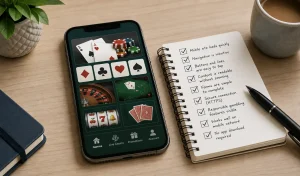


Availability can vary by account, so the cashier—not a general payment list—is the place to confirm the deposit route.
Check the cashier before assuming CashToCode is accepted
A casino page that mentions CashToCode is a clue, not confirmation that you can use it now. Payment information can stay online after a cashier has changed, and a page may describe a service without showing whether it is available to your account. I’ve learnt not to treat an old payment list as a promise. The useful check is the one you can make in the casino’s own cashier before you deposit.
Sign in to the account you intend to use and open the deposit area. Look for CashToCode in the methods actually offered there. If it is not shown, do not assume that a general page, an advert or a third-party list means it will appear later in the process. If it is shown, read the on-screen instructions and any conditions attached to that option before continuing. A method name on a page outside the cashier does not tell you whether the payment route is currently open to you.
That distinction matters when you are trying to identify casinos that accept CashToCode in the UK. A list headed “all” or “best” can sound definitive, but the label does not establish current availability. Nor does a casino being newly launched, having a UK-facing page or mentioning CashToCode somewhere on its site prove that the cashier supports it. I’d treat any such list as a starting point for checks, not as a reason to create an account or move money.
The cashier is also where you can see whether the method is presented for your particular account. Availability may not be identical across every page or situation, so check while signed in rather than relying on a screenshot or a payment guide written for someone else. If the option is missing, ask the casino’s customer support whether it is currently available to UK customers on your account. Keep the answer, but still check the cashier again before acting: a reply cannot make a button appear if the payment route is not offered there.
Be precise about what you are confirming. You are checking whether CashToCode is offered as a deposit method in that cashier, not whether a site has ever listed it or whether another player used it at some point. If the cashier gives a provider-specific instruction, follow what it says and stop if the details do not match what you expect. Don’t enter payment information into a page reached through an unrelated message or an unofficial link. Use the casino’s own signed-in account area.
Casinos That Accept Citadel in the UK
I’ve made the mistake of reading a confident payment claim and moving on before checking the actual account screen. It is an easy way to waste time. A quick check in the cashier is less glamorous than a “best” list, but it answers the practical question: is the method being offered to me here, now?
There is a useful ownership check too. Make sure the casino account details and the payment route belong to the same customer. When the names or basic ownership details do not line up, a straightforward transaction can attract avoidable questions. This does not prove that CashToCode is accepted, but it can prevent a separate account-detail problem from muddying the check.
The same caution applies to card information on casino pages. A specialist review may list Visa or Mastercard, but that is not confirmation that the particular card product you hold is eligible or available in a UK cashier today. Check the live payment screen rather than inferring acceptance from a logo or a general list. UK-licensed casinos cannot accept credit-card payments for gambling, so a card logo is not a reason to assume every card type can be used.
Before depositing, check that you are on a UKGC-licensed casino’s official site and verify its licence on the Commission’s public register. Then make the payment decision from the signed-in cashier, where the available option and its instructions are visible. Don’t let a familiar method name stand in for confirmation.
If CashToCode is absent, that is the answer for the cashier you checked; it is not evidence that another site offers it, or that an old page will become current. If you do find it, read the cashier’s terms before proceeding and make sure the account and payment details are yours. That small pause beats finding out after you have committed.
Do
- Sign in to your account before checking payment options
- Look for CashToCode directly in the casino’s cashier
- Verify the casino’s licence on the UKGC public register
Don’t
- Rely on general payment lists or logos on a website
- Assume a method is available based on third-party lists
- Create an account based on a payment claim without checking the cashier
Recommended online casinos
- x3betBonus: Welcome Pack 100% Up to £1.000 + 200 Free Spins · Payout speed: 1-3 business days
- EvoSpinBonus: 125% up to €2500 + 125 Free Spins · Payout speed: 1-3 business days
- NightLuckBonus: Welcome Pack + 805% Up To 6400€ + 280 FS · Payout speed: 1-3 business days
- BeOnBetBonus: 100% up to €500 + 100 FS · Payout speed: 1-3 business days
- DieselwinBonus: Welcome Pack 250% up to £4000 + 200 FS · Payout speed: 1-3 business days
- JetsetspinsBonus: 200% Bonus + 100 Free Spins + Free Royal Wheel · Payout speed: 1-3 business days
- ZombillionBonus: Welcome Pack 250% up to £4000 + 200 FS · Payout speed: 1-3 business days
- AmunbetBonus: Join now and get 450% up to 2,700 GBP + 450 FS · Payout speed: 1-3 business days
- SpinFormulaBonus: 550% Up To £15,000 + 550 FS · Payout speed: 1-3 business days
- BritsinoBonus: Welcome Package – Get your £2,200 + 2,000 FS · Payout speed: 1-3 business days
If CashToCode is missing, compare other ways to pay
If CashToCode is not among the choices you can use, there are other ways to fund a casino account. The sensible comparison is not just “which button looks familiar?” I check whether a method fits how I manage money, whether the cashier offers it, and what restrictions come with it. No payment route is automatically the right one for everyone.
Debit cards
Visa and Mastercard debit cards are commonly accepted at UK casinos. They can be a straightforward choice if you already use one for everyday banking: the payment comes from your bank account rather than a credit facility. Credit-card payments for gambling are prohibited at UK-licensed casinos, so do not treat a credit card as a substitute if a debit card is unavailable.
The card logos are only part of the decision. The cashier needs to offer the method, and your particular card must be eligible for the transaction. I’ve learned not to assume that a familiar logo means every card product will work. A decline does not necessarily tell you much beyond the fact that that payment attempt did not go through.
PayPal
PayPal can appeal if you already use it and prefer not to enter card details directly in every cashier. Its speed and convenience are often highlighted in specialist casino reviews, but that does not settle whether it suits a particular account or promotion. One wrinkle is bonus eligibility: PayPal may be excluded from a casino’s offer terms.
Casinos That Accept Maestro in the UK: What to Check
That caught my eye only after I had focused on the payment button and ignored the offer conditions. If a promotion matters to you, read its terms before choosing PayPal; do not assume that an accepted deposit method automatically qualifies. The cashier and the promotion rules answer different questions.
Bank transfers and open banking
A bank transfer is another route, while open banking can connect a payment to your bank through a service presented in the cashier. A specialist casino review describes open banking and transfers as capable of providing instant deposits and fast withdrawals at many sites. Treat that as a description of what some sites may offer, not a promise about every casino or transaction.
The exact route matters: a bank transfer and an open-banking payment are related, but they are not necessarily presented or processed in the same way. Check the label in the cashier and the operator’s payment information rather than guessing from the word “bank”. If you need a method that can also handle withdrawals, confirm that separately before depositing. A deposit button alone does not answer it.
Prepaid vouchers
Paysafecard is a prepaid voucher and is deposit-only. That makes it different from a bank-linked method: it can be used to add funds, but it is not a route for receiving a payout. I would not choose it on the assumption that money can later be sent back through the same voucher.
For some people, separating a purchase from their main bank account may feel easier to manage. Still, “prepaid” is not a magic label for control; you remain responsible for the amount you decide to spend. Check the casino’s cashier for availability and the voucher’s own instructions before buying one. Keep the withdrawal route in mind too.
Debit cards
Visa and Mastercard are common; payments come from your bank account rather than credit.
PayPal
Offers speed and convenience, but may be excluded from certain bonus offer terms.
Bank transfers
Includes open banking for instant deposits, though processing varies by operator.
Prepaid vouchers
Options like Paysafecard are deposit-only and cannot be used for withdrawals.
E-wallets
Skrill and Neteller appear at some casino sites, but their availability varies. A specialist casino review describes these wallets as often excluded from promotions, so check the specific offer terms if you plan to claim one. I would not infer eligibility from the fact that the cashier accepts the wallet.
An e-wallet can be a separate account to manage, but it adds another set of details to keep straight: the casino account, the wallet, and the funding source behind it. Use payment details that belong to you, and make sure you understand where a payment is coming from. A familiar wallet name does not make every route through it equivalent.
Make the comparison about fit
When I compare alternatives to CashToCode, I start with the practical differences. A debit card connects the transaction to a bank card; PayPal and e-wallets involve their own accounts; a bank transfer or open-banking option uses a bank route; Paysafecard is a deposit-only voucher. Those differences affect what each method can do, not just how its button looks.
Then I check the cashier, the payment terms and any promotion rules that matter to me. Don’t pick a method solely because it sounds “instant” or “easy”; those words do not confirm availability or suitability for your account. If one option is missing, another may be available, but the choice is casino-specific. Check first.
Deposits, prepaid vouchers and the minimum you may need
A CashToCode deposit is only useful if the amount you want to put in fits both the casino’s rules and the payment method’s own process. I’ve learned not to treat “prepaid” as shorthand for simple: the cashier can set a minimum, the provider can impose its own conditions, and the amount shown before confirmation is the one to check before you commit.
Casinos That Accept UKash in the UK: What to Check
For CashToCode, don’t assume a voucher amount or minimum just because a page describes the method. Check the current cashier and any instructions shown during payment. If the method is available, look at the lowest permitted deposit, whether the displayed amount is in pounds, and what happens if the transaction is declined. A payment option being named somewhere does not tell you what its current deposit terms are.
Deposit-only means just that
Paysafecard is a useful comparison because its role is clear: it is a prepaid voucher for deposits, not a withdrawal method. That distinction matters when you’re choosing how to fund an account. A deposit-only method can get money into the casino, but it should not be treated as a route for getting a payout back out.
Other payment types may support both directions at some casinos, but don’t infer that from the label on a cashier button. Check the deposit and withdrawal information for the specific account. I once assumed that a familiar payment logo meant the whole money route was sorted. It didn’t. The detail matters.
CashToCode should be treated the same way: confirm what the cashier allows it to do rather than assuming it works like a bank card, or that a prepaid balance can later receive a withdrawal. A deposit method and a payout method are not automatically the same thing.
What counts as a small deposit?
As a broad guide, a specialist casino review puts common minimum deposits in the £10–£20 range, with the precise threshold varying by payment method. Treat that as a starting point for checking, not a promise about every casino or a CashToCode-specific figure. The cashier is where you find the amount that applies to your account and chosen route.
Common minimum deposits at UK casinos typically range between £10 and £20, though the precise threshold depends on the payment method and the specific operator.
If you want to deposit less than the stated minimum, don’t try to work around it by making repeated smaller attempts. The transaction may simply fail, and repeated declines can make it harder to tell whether the issue is the amount, the payment details or the provider. Better to read the displayed terms first.
A low minimum also doesn’t tell you how much you can deposit overall. Maximums may apply per transaction, per day or per month, and can vary with the payment method and account status. So check both ends of the range before deciding that a route suits you.
Keep the amount and the account aligned
Before confirming a deposit, check that the amount on the casino screen matches what you intend to pay and that your account details belong to you. Using a payment route and account information under the same customer’s name can reduce avoidable friction over basic ownership checks.
If you’re using a voucher, keep its receipt or confirmation details until the deposit appears in your casino balance. If it doesn’t, avoid trying again straight away: first check whether the original payment is pending, declined or completed. That gives you a clearer record if you need to contact the casino or payment provider.
“Instant” is not a reason to skip the final screen. I’ve rushed that bit before. Not worth it.
Casinos That Accept AstroPay in the UK: What to Check
Using a payment method on mobile slots
A casino can mention a payment method on a general page without showing it in the cashier you reach on your phone. That distinction matters if you want to use CashToCode while playing mobile slots: a payment label is not confirmation that the option works in that particular mobile checkout.
I’ve learned not to treat a tidy list of logos as proof. A specialist review may list Visa and Mastercard, for instance, but that does not establish that either card product is eligible at every casino or currently available to a UK customer. The cashier is where you can see the methods presented for your account and the device you are using.
The practical check is straightforward. Sign in, open the casino’s cashier on the same phone you plan to use, and look at the deposit options before choosing a slot. If CashToCode is shown, follow the cashier’s steps and read any instructions it displays. If it is absent, don’t assume that switching from the mobile site to an app, or from one slot to another, will make it appear. You would need to check the operator’s own support information or ask support whether it is available to your account.
There are a few places where mobile access can trip you up. A payment page may open in a separate browser window, a pop-up may be blocked, or a form may be difficult to use on a small screen. Those are access problems, not proof that the method is accepted or rejected. I try the cashier first and avoid entering payment details into a page unless I can tell it belongs to the casino’s normal payment flow.
Mobile Payment Check
Step 1: Access the account
Sign in to the casino using the same mobile device you intend to use for playing.
Step 2: Open the cashier
Navigate to the deposit area within your signed-in account.
Step 3: Verify availability
Check the list of offered methods for CashToCode and read any on-screen instructions before proceeding.
The same caution applies to searches for online slots that take CashToCode or to claims about “free” CashToCode slots. A slot title does not tell you which payment options the casino offers, and “free” does not establish anything about depositing. Payment compatibility belongs to the casino account and its cashier, not to the individual slot machine.
If you can see the method on mobile but the payment does not proceed, pause rather than repeatedly submitting the same details. Check the on-screen message, confirm you are using the casino’s official site or app, and contact its support if the reason is unclear. Keep any transaction reference or error message to hand. Small screen, same rules.
I would also avoid switching devices midway through a payment unless the cashier clearly allows it. A method shown on a laptop is not a promise that the mobile cashier will present the same route. Check where you intend to transact, and let the displayed options—not a general payment list—guide you.
Real-money slots: keep play and account controls in view
A payment method and a slot game are separate parts of the experience. Seeing CashToCode mentioned alongside real-money slots does not establish that a particular casino accepts it, or that it will appear in that casino’s cashier when you want to deposit. Nor does a payment option tell you whether the site is suitable for you to play at. I would treat those as separate checks, not one reassuring “CashToCode slots” label.
For real-money play in Great Britain, the operator must hold the relevant UK Gambling Commission licence. Check the operator’s licence on the Commission’s public register before depositing; an attractive payment page is not a substitute. Remote gambling licensees must verify your age before allowing a deposit, and online gambling is legal for adults aged 18 and over at licensed sites. That is the basic gate, not a box to wave away.
Casinos That Accept eCheck in the UK: What to Check
The more practical check is what control the account gives you before money goes in. UKGC rules require a remote operator to prompt new customers to set a financial limit before their first deposit and to make account-level limit controls accessible. Take a moment to find those controls and understand what they apply to. I have learned not to assume I will make calmer decisions later, after a session has started. Set a limit you can live with, rather than treating the prompt as paperwork.
Real-money slots also have rules about how play works. In Britain, autoplay is not allowed, and each online slot spin must last at least 2.5 seconds. The maximum stake per game cycle is £5 for adults aged 25 and over; the £5 cap for all adults took effect on 9 April 2025. These rules apply to slot play, not to whether CashToCode is accepted. A cashier listing cannot override them.
I would also look for self-exclusion and the operator’s complaints route before relying on an account. UKGC-licensed casinos must provide responsible-gambling tools, including self-exclusion, and an internal complaints process with access to an approved Alternative Dispute Resolution service. These are not decorations. If something goes wrong, knowing where the controls and complaint steps are matters more than a payment brand printed on a page.
Keep the decision modest: confirm the operator is licensed, understand the account controls, and only then consider whether the payment route is available to you. A label promising “real money” says little about either. The boring checks count.
Licence Verification
Before depositing, you must verify that the operator holds a valid UK Gambling Commission licence via the public register to ensure legal protection.
Deposits are not the same as withdrawals
A payment method can work for a deposit without being available for a payout. I learnt not to treat the cashier’s deposit options as a promise about withdrawals: casinos may handle money going out differently, and the payment provider’s rules can also matter. For CashToCode, don’t assume that making a deposit means you can later withdraw directly to the same service. Check the casino’s withdrawal terms and the options shown in your account.
There is a reason casinos often send funds back to the original payment source. UK anti-money laundering rules generally require payouts to follow that route, and returning money to where it came from is also a common anti-fraud control. This is often described as a closed-loop approach. It can mean the casino will not simply let you choose any payout destination you like.
If the original source cannot receive a withdrawal, the casino may ask you to use another route. That can involve extra checks, because the operator needs to establish that the alternative account belongs to you and that the transfer is appropriate. Keep your casino details and payment account in your own name; mismatched ownership information can create avoidable friction.
The timetable is another thing I used to misread. A deposit may appear quickly, but a withdrawal can wait while the casino reviews and approves it. A specialist review notes that the first payout may take longer when KYC is still being completed. That is separate from the time a bank or payment provider takes after the casino releases the funds. Two stages, not one.
Casinos That Accept Bitcoin in the UK: Payment Checks
Before depositing, look for separate information about deposits and withdrawals rather than relying on a payment logo or a general claim that a method is supported. Check whether the method is listed for payouts, whether the casino requires a different route, and what verification is needed. If the terms are unclear, ask customer support before money is involved. I have skipped that step and ended up frustrated later. Not worth it.
A direct withdrawal through CashToCode should be treated as a possibility only if the casino explicitly says it supports that route for your account. The same applies if the cashier shows CashToCode for deposits: that alone does not establish payout availability. If a withdrawal is delayed, check whether it is awaiting casino approval or KYC before assuming the payment method has failed.
Bonuses can depend on how you deposit
A payment method being available in the cashier does not mean it qualifies for every promotion. I’ve learned not to treat the bonus banner as the full deal: the important detail is often tucked into the terms, where the casino explains which deposits count and which payment routes are excluded.
That matters if you are looking for a welcome offer at a casino that accepts CashToCode. First check whether CashToCode is actually offered to you, then read the promotion rules for that specific payment method before confirming a deposit. A general statement such as “new customers only” does not settle payment eligibility. Look for wording about excluded methods, qualifying deposits and whether a bonus code has to be entered.
The same applies to searches for CashToCode slots bonuses or no-deposit offers. A promotion’s label does not prove that it is available with CashToCode, or that every player can claim it. If the terms are unclear, ask support to confirm in writing before paying in. Better a dull answer now than a surprise later.
Attention Payment methods like PayPal, Skrill, and Neteller are often excluded from casino promotions; always read the offer terms before depositing.
Payment exclusions are not limited to vouchers. A specialist review has reported that PayPal may be excluded from bonus eligibility, despite being valued for speed and convenience. Specialist reviews have also described Skrill and Neteller as methods that can be excluded from promotions at some sites. Treat those statements as prompts to inspect the casino’s own terms, not as rules that apply everywhere. The offer can differ by operator and may change.
I’d check the payment clause, any code requirement, and what happens if a deposit is made with an excluded method. Some terms may say the deposit will not qualify; others may set out different conditions. Don’t assume that a bonus will be added automatically just because the cashier accepted the payment.
There’s a trade-off here. A promotion can look generous, but its restrictions may make it a poor fit for the way you want to pay. If keeping your preferred payment route matters more, skip the offer rather than changing methods without understanding the consequences. “Free” has footnotes. Read them first.
Small deposits, payment limits and account checks
A small test deposit sounds sensible, but the cashier’s minimum can make that plan impossible. A specialist review places common casino minimums in the £10–£20 range, with the exact entry point depending on the payment method. Treat that as a guide, not a promise: the amount shown beside a method in your own account is the one that matters.
E-Cheque Casinos in the UK: What to Check
I’ve learned not to assume a low figure from a payment page applies to every route. A voucher, card or other method can have a different minimum, and the cashier may show its own rules before you confirm. If you are trying to deposit a particular amount, check the displayed minimum first rather than finding out after you have entered payment details.
Maximums need the same care. A specialist review notes that casinos can set different ceilings for each transaction, each day or each month, and that an account’s status can affect them too. The cashier or account payment area should make the relevant cap clear. If a deposit is declined, splitting it into smaller payments is not automatically the answer; the method’s own rules and any account checks still apply.
There is also a basic ownership check worth getting right. Use account details and a payment route that belong to you. When names or other identifying details do not match, a transaction can face avoidable questions. I have made the mistake of treating a successful payment as proof that every account detail was in order. It isn’t.
For UK-licensed casinos, age verification must happen before a customer can deposit. Remote operators must also invite new customers to set a financial limit before their first deposit and make account-level limit controls accessible. Those controls are separate from the payment method’s deposit ceiling: one is a limit you can set for your gambling account, the other is a restriction on a transaction route or account.
If a cashier asks for information or documents, complete the check through the casino’s stated process and keep your details consistent. It can feel like needless friction when you only want to make a small deposit. Better to sort it first.
Account Funding Check
- Confirm the deposit amount meets the cashier’s minimum
- Verify that payment details match your casino account name
- Set a financial limit through the account controls
- Complete all required age and identity verification steps
Compare alternatives by their real cost
When I compare a CashToCode alternative, I don’t stop at the fee shown beside the payment button. The amount that leaves your account can also be affected by the casino, the payment provider, your bank or card issuer, currency conversion and, where relevant, a payment network. A “free” deposit can still cost you elsewhere.
Start with the currency. Check that your casino account and payment method are both set to GBP before you confirm. If either side converts the transaction, look at the exchange rate being applied, not just a stated charge. A conversion spread is the difference between the rate you might expect and the rate actually used; it can outweigh a visible flat fee. That is the sneaky bit.
Then check the fees at each stage. The cashier may show a casino charge, while the provider or your bank may apply a separate one. For a digital asset payment, network costs may also apply. Don’t assume every charge will appear on one screen: read the payment provider’s terms and check the transaction summary before authorising it.
Casinos That Accept Monzo in the UK: What to Check
To compare properly, use the same deposit amount and currency for each method, then add every fee and account for any conversion. The cheaper-looking option is not automatically cheaper once the rate spread is included. And a payment with no obvious charge is not necessarily cost-free.
I’ve made the mistake of picking the method with the tidiest-looking button and only checking the total afterwards. Now I compare the actual amount debited with the amount credited, and I check whether the casino or provider lists a fee before I press confirm. If the cost is unclear, pause rather than guessing.
There isn’t one payment route that wins on price for everyone. Charges depend on the casino, provider, issuer or bank, currency conversion and any network involved, so compare them for the amount you intend to deposit. A specialist payment review also notes that a conversion spread can exceed a flat charge; treat that as a reason to inspect the rate, not as a promise about what your own transaction will cost.
Casinos That Accept iDEAL in the UK: What to Check
Cheap on screen. Costly underneath.
GamStop searches do not confirm a payment route
I wouldn’t treat a casino described as “not on GamStop” as a confirmed place to use CashToCode. That label says nothing reliable about whether CashToCode appears in its cashier, and it does not establish that the site is authorised to serve customers in Great Britain. A payment name attached to a page or advert is not enough to settle either point.
For remote gambling offered to customers in Great Britain, the operator must hold the relevant UK Gambling Commission licence. A site outside that system is not a verified UK-licensed option, even if it claims to accept UK players or lists a familiar payment method. Before depositing, check the operator against the Commission’s public register. I would rather spend a minute checking than assume a polished payment page means the site is operating under the rules that apply here.
Casinos That Accept MuchBetter in the UK
The same caution applies to claims about CashToCode slots at casinos outside GamStop. A method being mentioned somewhere does not confirm that it is available to your account, or that it can be used for the transaction you have in mind. The cashier and the operator’s terms matter. Don’t let a broad label do the work of checking.
There is also a practical control worth keeping in view. UK rules require remote operators to ask new customers to set a financial limit before their first deposit and to make account-level limit controls accessible. I’d look for those controls before putting money in, and decide on a limit you can stick to. They are not a substitute for self-exclusion or other support if gambling is causing harm.
If you have chosen to self-exclude through GamStop, don’t look for another site as a workaround. Pause instead and use the support options available to you. CashToCode does not change that. The payment route is secondary; your account controls come first.
Material created by the team Basswin UK Guide